Why Your Guitar Buzzes - and How to Fix It
Fret buzz is the most common "my guitar is broken" panic there is, and most of the time the guitar is fine. This page finds your cause before you spend anything: read the triage table, run the free checks in order, and only then decide whether a product - or a luthier - is actually the answer.
Editorial guide from manufacturer facts and standard setup practice - not hands-on testing, and no hands-on review claims. Where a maker publishes no list price, cards are left unpriced on purpose.
Quick answer
Find where it buzzes before you fix anything. Buzz on one fret only usually means a high or worn fret (a luthier job). Buzz on every fret usually means the strings sit too low or the neck is too straight (a setup check). Buzz on open strings only usually means the nut or a string problem. Buzz everywhere after a string change usually means the new gauge is lighter, or the strings are simply dead. Work the table below top to bottom - most beginner buzz is fixed free.
Take the gear-fit quiz
Prices last checked: Oct 2026 where a verified price is shown on a card - confirm at checkout. Editorial from published facts, not hands-on testing: How we rate.
Step 1: the string-by-fret triage table
Play each string slowly, one fret at a time, and note exactly where the buzz lives. The pattern is the diagnosis - do not skip this and start turning screws.
| What buzzes | Most likely cause | First fix (free) | When it becomes a product or a pro |
|---|
| One string, one fret only | A high fret, a worn fret, or a dent in that string | Change that string if it is old or kinked, then retest | Still buzzing with a fresh string = fret work - luthier |
| One string, every fret | That string sits lower than the others, or its saddle/nut slot is worn | Check the string is seated properly at bridge and nut | Saddle or nut work - usually a luthier on a first guitar |
| All strings, most frets | String height (action) too low for how hard you play, or neck too straight/back-bowed | Play lighter for one song and see if it stops - technique first | A setup check; tools only if you will learn setups (below) |
| Open strings only, fine when fretted | Nut slots too low or worn, or a string too light for its slot | Try the capo test below to confirm the nut is the suspect | Nut repair or replacement - luthier; do not file a nut as a first DIY job |
| Buzz appeared right after new strings | Lighter gauge lowered tension and action slightly, or strings not yet settled | Play them in for a day, re-check tuning, retest | If the gauge is wrong for you, that is a string choice - see the gauge section |
| Buzz only when you strum hard | Normal string excursion meeting frets - often technique, not a fault | Strum closer to a moderate, even attack and compare | Only a problem if it buzzes at your normal playing volume through the amp |
| Rattle that is not at a fret | Loose hardware: tuner washers, strap buttons, pickup rings, a battery or wire inside | Tap and listen around the headstock and body while muting the strings | Tighten what is loose with the right-sized tool; electronics rattles = tech |
Why does my guitar buzz when I play a chord?
Chord buzz is usually not one cause but the sum of small ones: one finger a fraction too far behind its fret, one finger pressing lighter than the others, and the lowest string - which vibrates in the widest arc - kissing the next fret. Before touching the guitar, do the honest technique check: press each finger just behind its fret wire (not in the middle of the fret space), curl so fingertips come down vertically, and strum one string at a time inside the chord. If single notes are clean but the chord buzzes, it is finger placement, and no product fixes that - a week of slow chord changes does. If single notes buzz too, go back to the triage table.
Free check 1: is it actually in tune?
A string tuned well below pitch is looser, vibrates wider, and buzzes more - and beginners often diagnose "buzz" on a guitar that is simply flat. Tune up first, every time, before any diagnosis. Use our free browser tuner at home, and understand what a clip-on adds in our clip-on tuner accuracy guide. Electrics: also listen through your amp at practice volume. A surprising amount of acoustic buzz never survives amplification, because the pickup hears the string, not the fret rattle. If it is clean through the amp and only mildly buzzy unplugged, you may not have a problem worth spending on.
Free check 2: the capo-at-the-1st-fret test
This classic test separates nut problems from fret and setup problems, and it costs nothing if you own any capo. Put a capo on at the 1st fret and play each string up the neck. If the buzz disappears or moves, the nut slots were part of the story, because the capo has replaced the nut's job. If nothing changes, the nut is probably innocent and the cause is fret height, string height, or the string itself. No capo? A pencil laid across the strings at the 1st fret, held by a helper or a rubber band, does the same job roughly. And if your capo itself seems to cause buzzing or sharp notes, that is a different, very fixable problem - see our capos guide on spring-clamp vs adjustable tension and why clamping too hard pulls notes sharp, covered in best capos for beginners.
Free check 3: the dead-string test
Old strings buzz more: windings wear flat where they cross the frets, corrosion makes the string vibrate unevenly, and a kinked string buzzes at the kink no matter what you adjust. If your strings are dull, dark, rough to slide on, or older than the timeline in our how often to change guitar strings guide, change them before diagnosing anything else - a fresh set is the cheapest variable to eliminate, and you needed them anyway. Restring one string at a time, keep the guitar at pitch, stretch each new string gently (see our won't stay in tune guide for the stretch method), and retest your buzz map with the new set.
Why does my guitar buzz after changing strings - the gauge question
Gauge is tension. Swap to a lighter set and total tension drops, the neck relaxes slightly straighter, and the strings sit a touch lower - a guitar that was borderline now buzzes. Swap heavier and the opposite happens, at the cost of harder bending and sorer fingers. Neither is "wrong", but the change has to be a deliberate trade, not an accident at the shop counter. If you are not sure which gauge belongs on your guitar for your tuning and fingers, run the free string gauge finder and read our strings guide and the light vs medium strings comparison before buying another set. And note the reverse trap: fitting much heavier strings purely to stop buzz treats a symptom and can make a beginner stop playing - diagnose first.
How do I fix fret buzz on an electric guitar?
Everything above applies, plus three electric-specific checks. First, pickup height: pickups raised too high can pull strings magnetically and add a warbly rattle, especially on the low strings - if the buzz appeared after a pickup adjustment, that is your suspect (more in our pickups guide). Second, the amp test from the tuning section matters twice as much here. Third, hardware: loose tuner bushings, a rattling bridge saddle, or a tremolo spring can all impersonate fret buzz - mute the strings and tap around the guitar to locate a rattle before blaming frets. Our electric guitars guide covers the hardware you are looking at.
How do I fix fret buzz on an acoustic guitar?
Start with the same triage, then add the room. Dry indoor air shrinks wood, fret ends sprout, and the top can sink enough to lower the action - an acoustic that buzzes every winter is often thirsty, not broken. Read our guitar care and humidifiers page before adjusting anything. Acoustic saddle work (shimming or sanding a saddle) is the classic action fix and it is genuinely doable, but on a first guitar it is also easy to overshoot and create the opposite problem - that is why it sits behind the free checks, not in front of them.
The only products that honestly help - and when
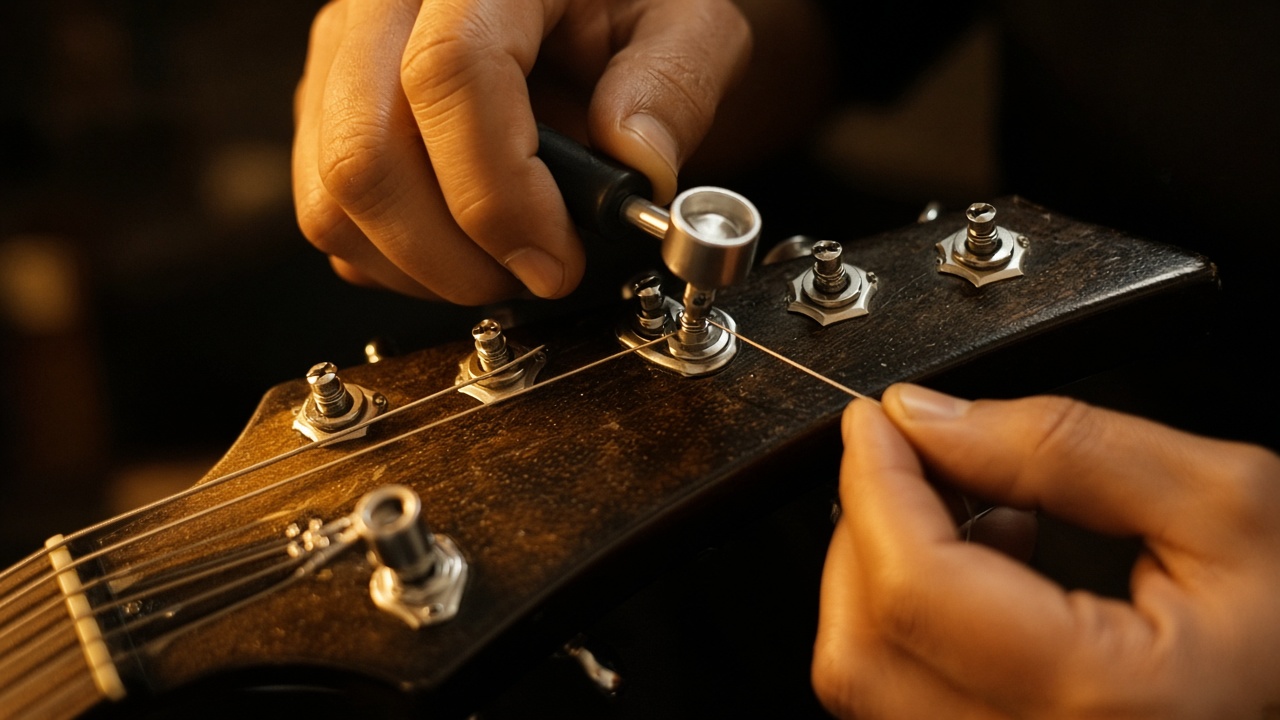
Notice what is not on this list: there is no spray, gadget, or miracle part that fixes fret buzz, because buzz is geometry, not dirt. Two verified products earn a place. A clip-on tuner makes every step above faster and more accurate - you will re-tune a dozen times during diagnosis, and the NS Micro below lives on the headstock while you work. A maintenance/setup kit makes sense only if you plan to check and adjust your own string height and relief more than once; for a single diagnosis, a luthier's setup fee is usually the smarter spend than a box of tools used once. Fresh strings are the third "product", but they are a consumable you already need - buy them for the dead-string test, not as a buzz cure.
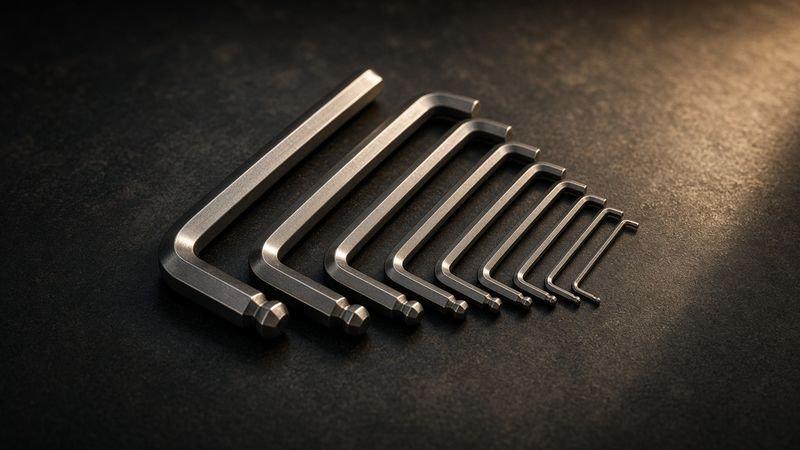
The cheaper alternative, if you do not want the full kit: if you don't want a full maintenance kit, the Bondhus 20199 22-piece ball-end set below covers every size a guitarist actually meets - .050" and 1.5mm for saddles, 1/8", 3/16", 4mm and 5mm for truss rods - in precision U.S.-made keys that won't round a truss nut. It is an alternative to the D'Addario kit above, not an add-on to it: the kit's folding multi-tool already includes .050, 1/8 and 3/16" plus 1.5, 2.5, 3 and 4mm keys, so if you own the kit you already own most of these sizes (its gaps are 5mm, ball ends, and the control a full-size L-wrench gives over a folding tool) - do not buy both to do the same job.
Use any hex key like it can hurt the guitar, because it can: only ever turn a nut with the exact snug size - never a close metric-for-imperial swap, which rounds the socket a little more every time. On a truss rod, use the flat short end of the key fully seated (ball ends are for getting into angled saddle screws and for low-torque work, not for truss torque), loosen the strings first, and move in small 1/8-turn increments, re-checking relief between turns. If the nut does not want to move, stop - that is exactly the luthier stop-line below, not a challenge. Most Gibsons, for the record, adjust with a 5/16" socket rather than a hex key, so this set does not cover them.
Illustration - AI-generated, not a photo of the exact product.
Step-upD'Addario Micro Universal Tuner (NS Micro)
Tiny and discreet: lives on the headstock, readable from front or behind - the always-there tuner
$22.99
Manufacturer/retailer list price (not an Amazon price): D'Addario product page (re-checked 2026-10-18) - checked 2026-10-18. Confirm before buying.
Clip-on headstock tunerreversible multi-color displaydual-swivel mount410-480Hz calibration range (per D'Addario)
Maker/retailer source for the price & specs above (citation, not a buy link): D'Addario
See price on Amazon
As an Amazon Associate, FretCompare earns from qualifying purchases. Price shown only on Amazon.
Illustration - AI-generated, not a photo of the exact product.
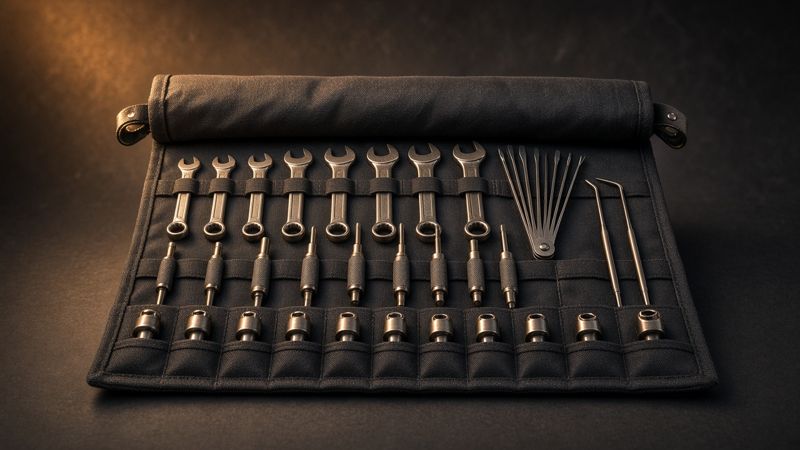
SeriousD'Addario Guitar Maintenance Kit
One kit for restringing, cleaning and basic setup checks
$99.99
Manufacturer/retailer list price (not an Amazon price): D'Addario product page - checked 2026-10-18. Confirm before buying.
Pro-Winderneck cradle/headstandmulti-toolstring height gaugefret polishing systemmat and case (per D'Addario)
Maker/retailer source for the price & specs above (citation, not a buy link): D'Addario
See price on Amazon
As an Amazon Associate, FretCompare earns from qualifying purchases. Price shown only on Amazon.
Illustration - AI-generated, not a photo of the exact product.
Step-upBondhus 20199 Balldriver L-Wrench Double Pack (BLX22, 22-piece)
The cheaper alternative to a full maintenance kit for saddle-height and careful setup checks: .050in and 1.5mm cover saddle screws, 1/8in (Fender USA truss), 3/16in (Fender Mexico truss) and 4mm/5mm (many import and Squier truss rods) cover the truss sizes guitarists actually meet. Honest limits: ball ends are for access at low torque - use the flat short end, fully seated, for a truss rod; and most Gibsons adjust with a 5/16in socket, not a hex key, so this set does not help there.
No list price listed here - we only publish prices we verified on a manufacturer/retailer page. Check the maker and Amazon for current pricing.
Ball-end L-wrenchesProTanium steelmade in USAlifetime warranty (per Bondhus). Metric 1.522.53456810mm + SAE .0501/165/643/327/641/89/645/323/167/321/45/163/8in; ball ends enter at up to 25 degrees (per Bondhus)
Maker/retailer source for the price & specs above (citation, not a buy link): Bondhus
See price on Amazon
As an Amazon Associate, FretCompare earns from qualifying purchases. Price shown only on Amazon.
Illustration - AI-generated, not a photo of the exact product.
Our pickElixir Electric NANOWEB Light .010-.046 (12052)
Our pick if .009s feel too slinky: the standard .010 electric gauge with coated life
No list price listed here - we only publish prices we verified on a manufacturer/retailer page. Check the maker and Amazon for current pricing.
Nickel-plated steelNANOWEB coatingbright tonesmooth feel (per Elixir)
Maker/retailer source for the price & specs above (citation, not a buy link): Elixir
See price on Amazon
As an Amazon Associate, FretCompare earns from qualifying purchases. Price shown only on Amazon.
Prices last checked: Oct 2026 where a verified price is shown on a card - confirm at checkout. Editorial from published facts, not hands-on testing: How we rate.
The luthier stop-line: when to put the tools down
Take it in, without embarrassment, when: the buzz is isolated to one fret with fresh strings; open strings buzz from a worn nut; the neck is visibly twisted; fret ends are lifting; or anything needs filing, levelling, crowning, or gluing. Those are skilled jobs with cheap-looking tools and expensive mistakes. We deliberately do not quote a setup or fret-dress price anywhere on this page: we could not verify a standard rate on a manufacturer page, and inventing one would be exactly the kind of made-up number this site refuses to print. Ask two local techs, and use our used guitar checklist thinking - play every fret - to describe the problem precisely when you go.
FAQ
Why does my guitar buzz when I play a chord?
Usually one of three things: a string is being pressed too lightly or too far behind the fret, the string is old and worn where it crosses the frets, or the string sits low enough to touch the next fret as it vibrates. Work the triage table above: find whether the buzz is on one fret, on every fret, or only on open strings, and fix that cause - not all three.
How do I fix fret buzz on an electric guitar?
The same diagnosis as acoustic: locate the buzz first, check tuning, try the capo test at the 1st fret to separate nut from fret causes, and rule out a dead string. Electric players add two checks - pickup height that is too high can pull and rattle strings, and buzz you hear acoustically may not come through the amp at all. Play through your amp before changing anything.
How do I fix fret buzz on an acoustic guitar?
Locate it, then check the string's age and the room: acoustics also buzz when very dry air lowers the action (see our care page). A buzz on open strings only points at the nut or a string that is too light for the guitar; a buzz everywhere points at string height or neck relief, which is a setup check, not a parts purchase.
Can new strings cause fret buzz?
Yes, two ways. Very fresh strings are brighter and can sound buzzier for a day, and changing to a lighter gauge lowers tension, which can lower the action slightly and make a borderline guitar buzz. That is why gauge changes belong in the diagnosis - run our string gauge finder before assuming the guitar is at fault.
When is fret buzz a luthier job, not a DIY fix?
When the buzz is on one single fret with clean strings at sane height (likely a high or worn fret), when open strings buzz from a worn nut, when the neck looks twisted, or when anything needs filing, levelling or gluing. We do not quote a setup price here because we could not verify a standard rate - ask locally.
Will thicker strings stop fret buzz?
Sometimes - a heavier gauge raises tension and can sit a little higher - but it is treating a symptom and makes the guitar harder to play. Diagnose the cause in the table first; change gauge for feel and tuning stability, not as a buzz bandage.
Setup hub: High action fix (hard to press instead? start there) - Guitar intonation fix - Fret sprout fix - Why your guitar won't stay in tune - Strings guide - String gauge finder - Tuners - Care & humidifiers
 ILLUSTRATION