Sharp Fret Ends (Fret Sprout): Fix Them Without Ruining Your Neck
One month your guitar feels fine, the next the fret ends are nicking your hand like little knives. That is fret sprout, it is seasonal, and the internet's favourite fix - file them - is the one step you should take last, not first. This page humidifies before it files, on purpose.
Editorial guide from manufacturer facts and standard practice - not hands-on testing. No tech or repair price is quoted anywhere here, because we could not verify a standard one.
Quick answer
Do not file yet. Fret sprout usually means the fretboard dried and shrank while the metal frets stayed the same length, so the ends stick out. Put the guitar in its case with a humidifier and give it days to a couple of weeks - the wood often swells back and the ends retreat on their own. Filing is irreversible: ends filed flush in dry winter air can end up recessed when summer humidity returns. Humidify, wait, re-check - then file minimally, or pay a tech, only for what is still sharp.
Take the gear-fit quiz
Prices last checked: Oct 2026 where a verified price is shown on a card - confirm at checkout. Editorial from published facts, not hands-on testing: How we rate.
What is fret sprout, exactly?
Frets are metal tangs set into slots across the fretboard, cut roughly flush with the board's edge when the guitar is built. Wood moves with moisture; metal barely does. In heated winter rooms the board loses moisture and narrows slightly, and every fret end is suddenly a fraction proud of the edge - you feel it as a row of sharp points when you slide your hand along the neck. It is at its worst on wider boards, in very dry homes, and on guitars stored out of their cases near radiators. It can scratch skin, so treat the edges gently until fixed, but do not mistake it for a broken guitar: it is a moisture reading written in metal, and it usually reverses the way it came.
Diagnose first: sprout, one bad fret, or a sharp board edge?
Run a fingertip (carefully) and then the side of your thumb along both edges of the neck, one fret at a time. Three different problems feel similar and have three different fixes. True sprout: most or all fret ends feel sharp on both sides, and it arrived with the dry season or a move to a drier home - that is this page. One or two lifted or poorly dressed ends: a single fret catches while its neighbours are smooth; that can be a fret that was never dressed well or has lifted slightly, and it is a smaller, more local job (see the one-fret logic in our fret buzz guide - a lifted fret often buzzes too). A sharp fretboard edge itself: the wood edge feels like a knife corner even between frets; that is edge rolling/dressing from manufacture, not sprout, and humidifying will not change it. Naming which one you have stops you applying a whole-neck cure to a one-fret problem.
Step 1 (free): rehumidify before you touch a file
Case the guitar with a working humidifier - the two-way packs and soundhole humidifiers below are the catalog options - and keep it closed except to play. Check the ends every few days with the same fingertip test. Boards recover slowly; give it days and, for a very dry guitar, up to a couple of weeks. Our care and humidifiers page explains the 45-50% relative-humidity target D'Addario publishes for its Humidipak and how to choose between packs and soundhole units, and the Humidipak vs Humitar comparison covers which suits a case-stored guitar. If the ends retreat - and they commonly do - you have fixed fret sprout for the price of water and patience, and learned the one maintenance lesson that also prevents cracks and sunken tops.
Illustration - AI-generated, not a photo of the exact product.
Step-upD'Addario Humidipak Maintain Kit
Acoustic owners in dry/heated homes - prevents cracks, sharp frets and sunken tops
No list price listed here - we only publish prices we verified on a manufacturer/retailer page. Check the maker and Amazon for current pricing.
Two-way case humidity controlautomatically maintains 45-50% RH3 packets + pouches (per D'Addario)
Maker/retailer source for the price & specs above (citation, not a buy link): D'Addario
See price on Amazon
As an Amazon Associate, FretCompare earns from qualifying purchases. Price shown only on Amazon.
Illustration - AI-generated, not a photo of the exact product.
StarterMusicNomad The Humitar Acoustic Guitar Humidifier (MN300)
Simple soundhole humidity for an acoustic kept in its case - check and re-wet the sponge regularly in dry months
No list price listed here - we only publish prices we verified on a manufacturer/retailer page. Check the maker and Amazon for current pricing.
Soundhole humidifier: sponge humidifier that rests between the strings over the soundhole (MusicNomad Humitar line)
Maker/retailer source for the price & specs above (citation, not a buy link): MusicNomad
See price on Amazon
As an Amazon Associate, FretCompare earns from qualifying purchases. Price shown only on Amazon.
Illustration - AI-generated, not a photo of the exact product.
StarterKyser Lifeguard Acoustic Guitar Humidifier (KLHA)
Covers the soundhole so moisture stays in the body - a long-running, inexpensive dry-climate safeguard
No list price listed here - we only publish prices we verified on a manufacturer/retailer page. Check the maker and Amazon for current pricing.
Soundhole humidifier covering the soundhole to hold case humidity (Kyser Lifeguard line)
Maker/retailer source for the price & specs above (citation, not a buy link): Kyser
See price on Amazon
As an Amazon Associate, FretCompare earns from qualifying purchases. Price shown only on Amazon.
Prices last checked: Oct 2026 where a verified price is shown on a card - confirm at checkout. Editorial from published facts, not hands-on testing: How we rate.
Step 2: reassess honestly - and protect the return window
After humidifying, retest every fret. If the ends are smooth again, stop: you are done, and the correct ongoing fix is keeping the guitar humidified each dry season. If the guitar is new and still returnable, stop even earlier - sharp ends on a new guitar are the seller's problem. Do not file a guitar you may return: filing is exactly the kind of modification that can close the return window and convert a shop's warranty job into your permanent neck. Ask the shop to dress the ends or exchange the guitar. The same goes for a used guitar bought this week with an approval period - diagnose, photograph, and talk to the seller first (our used guitar checklist treats sharp ends as an inspection item for this reason).
Step 3 (only if it survives Steps 1-2): dressing fret ends, conservatively
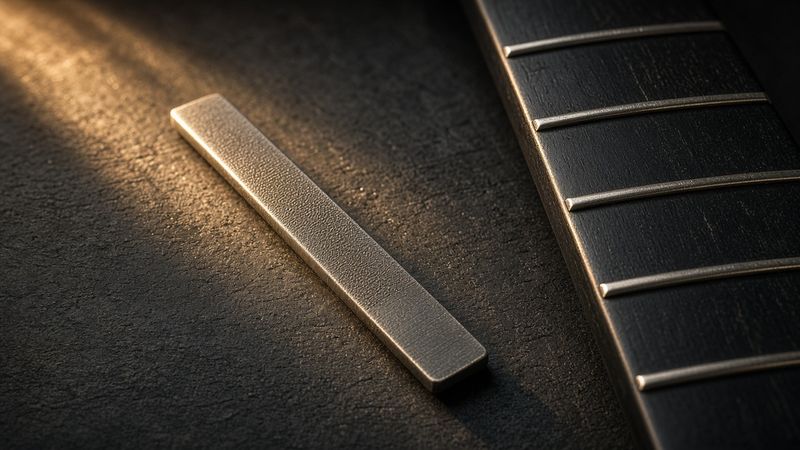
If humidified ends are still sharp weeks later, the remaining fix is a fret-end dress: mask the fretboard and binding thoroughly with tape so only the fret ends are exposed, then take the ends down flush and round them with a fret-end dressing file - a small file made with safe edges so it kisses metal without gouging wood - working at an angle along the board edge, checking constantly, and polishing afterwards. The discipline matters more than the tool: remove the minimum, keep the file off the board, and stop the moment an end feels smooth rather than chasing a mirror finish. One file earns a specific mention because we could verify it properly: MusicNomad's MN830 is a diamond-coated fret end dressing file built for exactly this job, with the safe edges that keep the file on metal and off wood, and its maker list price was verified on MusicNomad's own product page (below). Everything else in this class gets a description, not a recommendation. First-timers should practise the motion on the highest, least-played fret, and anyone whose hand is hovering over a valuable or vintage guitar should read the next section twice.
Illustration - AI-generated, not a photo of the exact product.
Step-upMusicNomad Diamond Coated Fret End Dressing File (E-File, MN830)
The specific tool for fret sprout that survives rehumidifying: dress only the ends still sharp, board masked, minimum material - filing is irreversible, so this is a use-it-for-years tool, not a one-winter impulse.
$29.99
Manufacturer/retailer list price (not an Amazon price): Maker list price (not an Amazon price): musicnomadcare.com MN830 product page - checked 2026-10-19 - checked 2026-10-18. Confirm before buying.
Diamond-coated fret end dressing file (E-File) with safe edges for dressing sharp fret ends (per MusicNomad)
Maker/retailer source for the price & specs above (citation, not a buy link): MusicNomad
See price on Amazon
As an Amazon Associate, FretCompare earns from qualifying purchases. Price shown only on Amazon.
Prices last checked: Oct 2026 where a verified price is shown on a card - confirm at checkout. Editorial from published facts, not hands-on testing: How we rate.
When a tech is the right answer (and what to ask)
Choose a tech when: the guitar is new/returnable (seller first, then their tech), the board is bound or the finish is delicate, only one or two frets are lifted rather than sprouted, you can feel movement in a fret, or you simply do not trust your file control - a fret-end dress is a small, common bench job and a botched home filing is not small to undo. Ask for "a fret-end dress" by name, ask whether they would humidify first (a good tech will), and ask the price before agreeing: repair pricing varies by region and workload, which is precisely why this page prints no figure. Anyone searching "fret sprout repair cost" deserves that straight answer - it is a quote, not a constant.
FAQ
How do I fix fret sprout?
In this order: confirm it is sprout (many sharp ends, worse in the dry season), rehumidify the guitar in its case and give it days to a couple of weeks - ends often retreat as the board takes up moisture - then reassess. Only if sharp ends remain, mask the board and dress the ends minimally, or take it to a tech. Filing first is backwards, because filing is permanent and sprout often is not.
What tool do I need for fret sprout?
The tool class is a fret-end dressing file (a small file with safe, smooth edges) plus masking tape and polishing material. The specific one featured on this page, MusicNomad's MN830, has its maker list price ($29.99) verified on musicnomadcare.com - practise on the least-visible fret first if you go ahead.
How much does fret sprout repair cost?
It varies too much by region and by whether the guitar also needs a setup for us to print a figure - we will not invent one. Ask a local tech for a fret-end dress quote and compare it honestly with the cost of a file you may use once; on a guitar you could still return, the repair cost should be zero because the return is the right move.
Sharp fret ends on a new guitar - should I file them?
No - not before talking to the seller. Sharp ends on a new guitar are a warranty/return conversation first, and filing ends can void your ability to return it. If you love everything else about the guitar, ask the shop to dress the ends or humidify it in-store and re-check; filing someone else's unsold guitar is how a fixable problem becomes yours permanently.
Does fret sprout mean my guitar is damaged?
Usually not. Sprout is normally a moisture story, not a breakage story: the board shrank, the metal frets did not, and the ends stand proud until the wood recovers. It becomes damage mainly when someone files aggressively in winter and leaves the ends recessed when summer humidity returns - which is why this page humidifies first.
Setup hub: Fret buzz fix - High action fix - Guitar intonation fix - Won't stay in tune - Care & humidifiers - Tools & care kit
 ILLUSTRATION