Affiliate disclosure: product buttons link to Amazon. As an Amazon Associate, FretCompare earns from qualifying purchases, at no extra cost to you. It never changes which products we pick, and we never show Amazon prices. Details
How to Hold a Guitar Pick: Grip, Angle and Pressure
Last verified Oct 2026. Facts on this page come from the official pages listed under Sources checked. Editorial guidance, not hands-on testing. See the sources.
Quick answer
Rest the pick on the side of your index finger, curl the finger towards your palm, and lay the pad of your thumb flat on top, so the pick points at right angles to your thumb. Let a little of the tip show: more for strumming, less for single notes. Grip just firmly enough that it doesn't slip, and keep your hand relaxed.
Step-by-step grip
Relax your picking hand and curl your fingers loosely, as if holding a cup handle.
Lay the pick on the outside of the index finger's last joint, with the point aimed away from your palm.
Press the pad of your thumb flat on top. The pick should point roughly at right angles to your thumb.
Show about a fingernail's width of tip for single notes, and a bit more for strumming.
Keep your other fingers loosely curled or resting lightly. Don't clench them into a fist.
How hard should you grip?
Try this test: a friend should be able to pull the pick out with a gentle tug. If your forearm aches after a song, you are squeezing too hard. When strumming, a slightly looser grip lets the pick give a little against the strings.
Angle and motion
Hit the strings with the pick almost flat, tilted slightly so the edge slides through. Strum from the wrist and forearm, not the shoulder. For single notes, keep small movements close to the strings.
Common problems and quick fixes
The pick spins round in your fingers: press with the flat pad of the thumb, not the tip. More fixes are in pick keeps slipping.
You drop it mid-strum: show less tip and loosen your wrist rather than your grip.
The pick catches on the strings: tilt it a little more and show less tip.
Which pick should a beginner use?
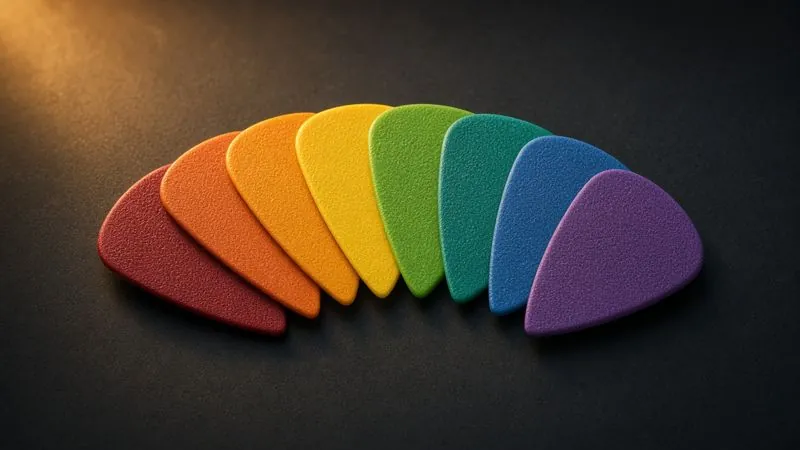
A medium-thickness standard pick is the usual starting point. Thin picks are easy to strum with, and thicker ones are more controlled for single notes. Our picks guide compares the options. If you need a pick to practise this grip with, this is the standard pick we have verified:
ILLUSTRATION
Illustration - AI-generated, not a photo of the exact product.
Starter
Dunlop Tortex Standard Picks (.50/.60/.73/.88/1.0)
Best for Buy single gauges once the variety pack tells you your thickness
Delrin (acetal) matte grippy pickscolour-coded by gauge (per Dunlop)
Specs: Dunlop official product page, checked 2026-10-18.
As an Amazon Associate, FretCompare earns from qualifying purchases. Price shown only on Amazon.
Safety: if your hand or wrist hurts (not just tired), stop, rest and loosen your grip. Pain that keeps coming back is worth checking with a teacher or a clinician.
FAQ
Should I strum with my fingers instead?
Either way is fine. Many beginners start with a pick because strums sound more even. See your first 30 days for a practice plan.
Sources checked
Fender: How to Hold a Guitar Pick (checked Oct 20 2026): www.fender.com/articles/techniques/get-a-grip-how-to-hold-a-pick
Not hands-on testing: FretCompare summarises official instructions and published facts. Steps and terms change, so follow the official page if it differs.
Free 7-Day First Chords course - Confirm your email first (Kit sends a confirmation link). Day 1 arrives the next morning (about 9 AM Central), then one short email a day until Day 7: setup, first chords, strumming, a first song. Unsubscribe any time.
 ILLUSTRATION