Pick Keeps Slipping? Grip Fixes That Actually Work
If your pick rotates, slides, or launches itself across the room mid-chorus, you are in the most fixable problem in guitar. This page goes technique first - because grip geometry solves most of it free - then texture, thickness and shape, where a few dollars of the right pick honestly finishes the job.
Editorial guide from manufacturer specs and standard teaching practice - not hands-on testing. Our catalog prints a price only where we verified a maker list price; pick prices below are therefore shown on Amazon, not invented here.
Quick answer
Your pick slips because it is balanced between two fingertips instead of clamped flat. Curl your index finger, lay the pick on its pad, and close your thumb across it so only the tip peeks out - then, if it still moves, switch from a glossy pick to a matte textured one (Tortex-style) in a standard size. Grip position first, angle second, texture third; squeezing harder is not on the list, because a tense hand strums worse and drops the pick anyway.
Take the gear-fit quiz
Prices last checked: Oct 2026 where a verified price is shown on a card - confirm at checkout. Editorial from published facts, not hands-on testing: How we rate.
Fix 1 (free): hold the pick like you mean it
The coin grip - pick pinched between the very tips of thumb and index - is how almost every beginner starts, and it is a pivot waiting to spin. Change the geometry: make a loose fist, lay the pick on the side pad of your curled index finger (pointing the tip out past your fingertip), then bring your thumb down flat across it. Now the pick is sandwiched between two flat surfaces with most of its body under your thumb, and only a small tip exposed to the strings. Play a few strums and notice how much less the pick can rotate: you have removed the pivot rather than fighting it. Two refinements matter as much as the grip itself. First, how much tip shows: too much exposed pick digs in and gets levered around; too little and your fingers hit the strings. A few millimetres is the usual teaching starting point - adjust by feel from there. Second, finger moisture: wipe your hands (and, honestly, the pick) before playing; oils and sweat are a lubricant working against every other fix on this page.
Fix 2 (free): angle the pick, don't present it flat
A pick pushed through the strings dead-flat grabs maximum string and gets torqued on every stroke. Angle it slightly - rotate your hand so the pick's edge leads a little on the downstroke, the technique often called edge picking - and it slices through with less resistance and far less twisting force. This is also a tone control: more angle softens attack and quiets pick noise, less angle brightens and sharpens it. For strumming specifically, relax the wrist and let the pick flex across the strings rather than ploughing through them; a strum is a brush, not a dig. If the pick only slips on upstrokes, your angle is asymmetric - the edge that leads going down is trailing coming back - so even it out before buying anything. Our picks guide shows the gauges and shapes these angles pair with.
Why does my pick keep slipping while strumming?
Strumming is the slipping stress-test: alternating drag directions, a deliberately relaxed hand, and often a thin flexible pick flicking as it exits the strings. The beginner combination - glossy celluloid pick, coin grip, flat angle, thin gauge - maximises every factor at once, which is why new players drop picks inside the soundhole with such reliability. Change one variable at a time so you know what fixed it: grip first (a practice session), angle second (a practice session), and only then conclude you need a different pick. Most players who do the first two honestly find a standard textured pick in a medium-light gauge ends the problem for good.
Fix 3: texture and material - where a few dollars honestly help
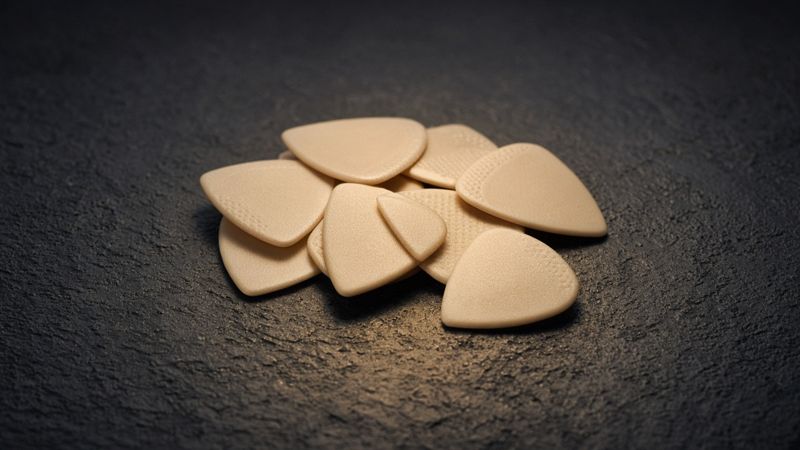
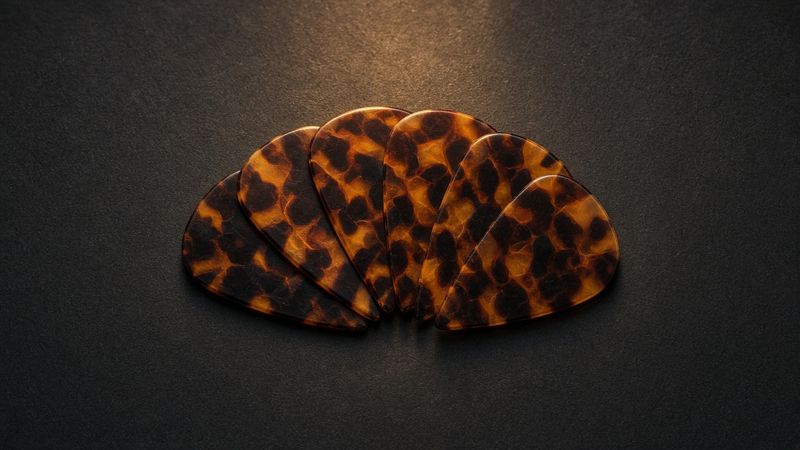
This is the rare page where the product is the fix, so let us be specific without inventing facts. Celluloid (the classic Fender 351 below) is smooth, warm-sounding - and the most slippery common material; if your pick is shiny tortoiseshell-look, it is working against you. Tortex (Dunlop's Delrin) has a matte, slightly chalky feel that grips noticeably better and is colour-coded by thickness - the beginner default for a reason. Nylon sits between, and textured/raised-grip designs go further: Dunlop's Max-Grip line, for example, is a nylon pick with a raised non-slip surface - Dunlop lists its variants on jimdunlop.com, but the price changes with gauge and pack size, so on this page it gets an honest mention and no made-up price; use the Amazon buttons on the catalog picks below to compare textured options live. Other grip tricks, ranked by honesty: a drop of rosin-style grip aid works but is a consumable you may not need once texture is right; scoring a smooth pick with a knife or hole-punching it does add grip but weakens it - at pick prices, just buy the textured ones. And sweat-prone hands (our strings guide readers with rusty-string problems know this one) may prefer the grippiest texture in the pack and a spare pick on the mic stand or pickguard.
Fix 4: thickness and size for the job
Thickness changes how much the pick fights back. Thin picks (around .50-.60mm in the sets below) flex across the strings - forgiving for strumming, but that flick can work them loose in a light grip. Medium-light to medium (roughly .60-.88mm) is where most strummers settle: enough flex to be kind, enough body to control. Heavy picks (1.0mm and up, and the small Jazz III at 1.38mm) are single-note precision tools - wonderful for leads, more likely to be levered around in a loose strumming hand. Size is the same trade: a standard 351-shape body gives your thumb a big clamping area; a small jazz pick deliberately shrinks that area for players whose grip is already locked in. If your pick rotates, going bigger and more textured beats going smaller, whatever your favourite lead player uses. A variety pack is the risk-free way to audition all of this - twelve picks across gauges costs less than one wrong guess bought twelve times, and the LT/MD variety pack below is the catalog's ready-made version.
Illustration - AI-generated, not a photo of the exact product.
StarterDunlop Tortex Standard Picks (.50/.60/.73/.88/1.0)
Buy single gauges once the variety pack tells you your thickness
No list price listed here - we only publish prices we verified on a manufacturer/retailer page. Check the maker and Amazon for current pricing.
Delrin (acetal) matte grippy pickscolour-coded by gauge (per Dunlop)
Maker/retailer source for the price & specs above (citation, not a buy link): Dunlop
See price on Amazon
As an Amazon Associate, FretCompare earns from qualifying purchases. Price shown only on Amazon.
Illustration - AI-generated, not a photo of the exact product.
StarterJim Dunlop LT/MD Variety Pack PVP101 (12 picks)
Start here: one pack answers the thickness question by feel
No list price listed here - we only publish prices we verified on a manufacturer/retailer page. Check the maker and Amazon for current pricing.
Mixed materials and gauges incl. Tortex .60/.73 - find your thickness in one pack
Maker/retailer source for the price & specs above (citation, not a buy link): Dunlop
See price on Amazon
As an Amazon Associate, FretCompare earns from qualifying purchases. Price shown only on Amazon.
Illustration - AI-generated, not a photo of the exact product.
Step-upDunlop Jazz III Picks, Red Nylon 1.38mm
Fast, precise picking and lead work once strumming is solid
No list price listed here - we only publish prices we verified on a manufacturer/retailer page. Check the maker and Amazon for current pricing.
Small sharp-tip nylon pick1.38mmquick release edge (per Dunlop listings)
Maker/retailer source for the price & specs above (citation, not a buy link): Dunlop
See price on Amazon
As an Amazon Associate, FretCompare earns from qualifying purchases. Price shown only on Amazon.
Illustration - AI-generated, not a photo of the exact product.
StarterFender 351 Shape Celluloid Picks
Traditional warm celluloid feel in the most common shape
No list price listed here - we only publish prices we verified on a manufacturer/retailer page. Check the maker and Amazon for current pricing.
Classic 351 celluloid shape in thin/medium/heavy gauges (per Fender pick guides)
Maker/retailer source for the price & specs above (citation, not a buy link): Fender
See price on Amazon
As an Amazon Associate, FretCompare earns from qualifying purchases. Price shown only on Amazon.
Prices last checked: Oct 2026 where a verified price is shown on a card - confirm at checkout. Editorial from published facts, not hands-on testing: How we rate.
Our recommended grip pick - and two honest alternatives
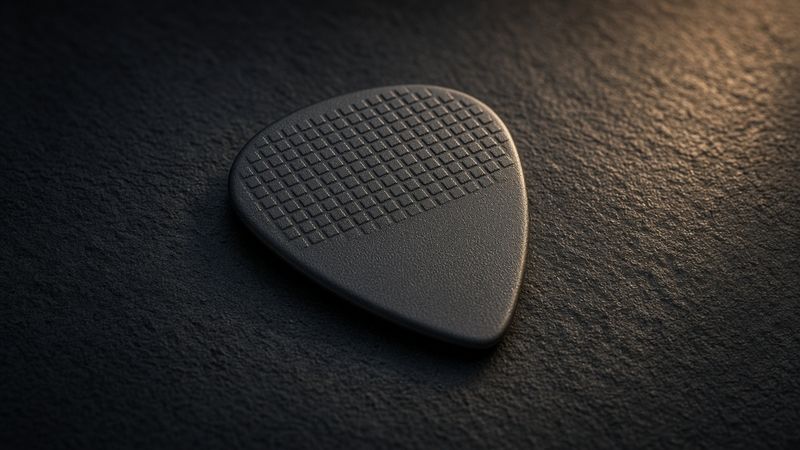
OUR RECOMMENDED / WINNER: the Jim Dunlop Max-Grip Nylon Standard .73mm. If texture is your fix, start with the Dunlop Max-Grip Nylon Standard in .73mm - its raised molded grid gives your thumb something mechanical to hold, in a full-size pick that still flexes kindly for strumming. One honest caveat: nylon flexes more than Tortex at the same gauge, so heavy hands should step up to the .88mm version of the same pick. The two alternatives below are genuinely good, with their own caveats stated on their cards: the Gator Grip's matte surface can wear smooth (and its grip reviews are mixed), and the Snarling Dogs Brain pick is smaller-bodied and pricier per pick - the Max-Grip wins because it pairs the most aggressive grip texture with the standard body most strummers already know.
Illustration - AI-generated, not a photo of the exact product.
StarterJim Dunlop Max-Grip Nylon Standard .73mm (449P073, 12-pack)
Our recommended grip pick: the raised grid gives your thumb something mechanical to hold, in a full-size pick that still flexes kindly for strumming. Honest caveat: nylon flexes more than Tortex at the same gauge - heavy hands step up to .88mm.
No list price listed here - we only publish prices we verified on a manufacturer/retailer page. Check the maker and Amazon for current pricing.
Nylonraised molded coarse grip gridfull standard 351 body; gauges .60/.73/.88/1.0/1.14/1.5mm (per Dunlop); this .73mm 12-pack (449P073)
Maker/retailer source for the price & specs above (citation, not a buy link): Dunlop
See price on Amazon
As an Amazon Associate, FretCompare earns from qualifying purchases. Price shown only on Amazon.
Illustration - AI-generated, not a photo of the exact product.
StarterDunlop Gator Grip .58mm (417P058, 12-pack)
Matte-grip alternative in a thin, forgiving .58mm strumming gauge. Honest caveat: the matte grip can wear smooth over time, and grip reviews are mixed.
No list price listed here - we only publish prices we verified on a manufacturer/retailer page. Check the maker and Amazon for current pricing.
Matte gripping surfacebeveled edges; gauges .58-2.0mm (per Dunlop); this .58mm 12-pack (417P058)
Maker/retailer source for the price & specs above (citation, not a buy link): Dunlop
See price on Amazon
As an Amazon Associate, FretCompare earns from qualifying purchases. Price shown only on Amazon.
Illustration - AI-generated, not a photo of the exact product.
StarterSnarling Dogs Brain Picks by D'Andrea, .73mm (TNSDB351, 12-pack in tin)
Textured-grip pick in a keep-it-in-the-case tin. Honest caveat: smaller body than a standard pick, and pricier per pick.
No list price listed here - we only publish prices we verified on a manufacturer/retailer page. Check the maker and Amazon for current pricing.
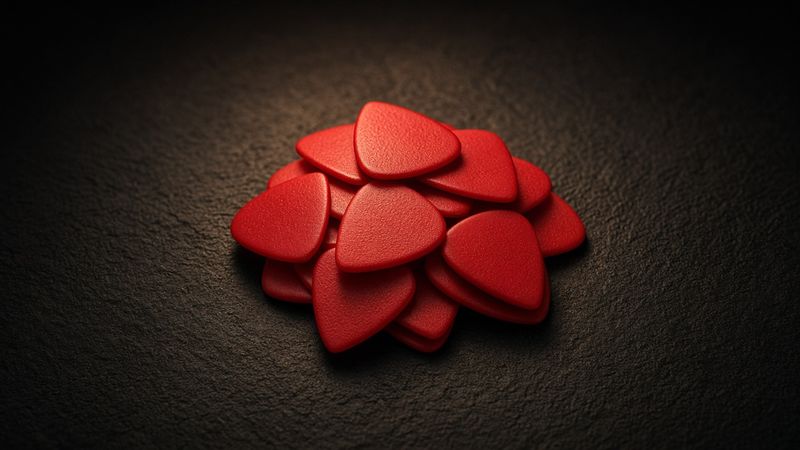
Red nylontextured non-slip grip surface; six gauges/colours sold separately (per D'Andrea); this .73mm 12-pack in a collectible tin (TNSDB351)
Maker/retailer source for the price & specs above (citation, not a buy link): D'Andrea
See price on Amazon
As an Amazon Associate, FretCompare earns from qualifying purchases. Price shown only on Amazon.
Prices last checked: Oct 2026 where a verified price is shown on a card - confirm at checkout. Editorial from published facts, not hands-on testing: How we rate.
A one-week plan that ends the problem
Day one: change the grip and play only slow strums, re-seating the pick between patterns instead of mid-pattern. Days two and three: add edge angle and your usual songs at reduced speed. Day four: if it still moves, the pick is the variable - open the variety pack and play the same song with each gauge, keeping the one that survives a full chorus. By the end of the week you will know whether you were a technique fix, a texture fix, or both - and you will own a small pile of picks, which every guitarist ends up needing anyway. Players who go on to develop their strumming further will find the patterns in our strumming patterns library are excellent pick-retention training without meaning to be, and if dropped picks inside an acoustic are your current hobby, fish it out by shaking gently over a bed - and then re-read Fix 1.
FAQ
Why does my pick keep slipping while strumming?
Strumming is the worst case for grip: every downstroke drags the pick one way and every upstroke drags it back, while a relaxed strumming hand holds it lightly by design. Smooth celluloid picks, a fingertip-only grip, and strumming with the full flat of the pick all make it worse. The fixes in order are grip position, pick angle, then texture - most players solve it at texture.
Why does my pick keep rotating between my fingers?
Rotation means the pick is being held like a coin between fingertips, so it pivots. Hold it on the pad of your curled index finger with your thumb across it, leaving only the tip showing - the pick is then clamped on a flat surface instead of balanced on two points, and rotation mostly stops. A textured pick finishes the job.
How do I stop my guitar pick slipping out of my hand?
Dry your hands, then address the pick, not your strength: squeezing harder causes fatigue and worse strumming. Switch from glossy celluloid to a matte textured material (Tortex is the classic example), try a pick with a raised grip surface, and make sure enough pick is gripped - a tiny exposed tip on a big pick body gives your fingers more to hold.
What pick is best for strumming without dropping it?
For strummers: a standard-size (351-shape) pick in a light-to-medium gauge - roughly the .60-.73mm range in the catalog picks below - with a matte or textured finish. Thin picks flex and flick; very small picks (jazz size) and very thick picks suit controlled single-note playing, not relaxed strumming.
Do grip picks like the Dunlop Max-Grip actually help?
The idea is sound and we can say so without inventing a price: a raised, textured surface gives your thumb something mechanical to hold, which is exactly what a rotating pick needs. Dunlop lists Max-Grip variants on jimdunlop.com, but the price varies by gauge and pack size, so we do not print a single figure here - check the Amazon buttons on the textured catalog picks below, and treat any grip pick as a cheap experiment in a variety pack first.
Should I just hold the pick tighter?
No - that is the one fix that backfires. A clamped hand strums stiffly, tires fast, and still loses the pick on the first sweaty chorus. Loose-but-correct grip geometry plus the right texture beats grip strength at every level; even the pros who play hardest hold the pick surprisingly lightly.
Related help: Guitar picks guide: thickness, materials & shapes - Fret buzz: find the cause & fix it - Why your guitar won't stay in tune - Strumming patterns - Accessories checklist
 ILLUSTRATION