Affiliate disclosure: product buttons link to Amazon. As an Amazon Associate, FretCompare earns from qualifying purchases, at no extra cost to you. It never changes which products we pick, and we never show Amazon prices. Details
Your First Jam Session: Guitar Jam Etiquette and How to Prepare
Quick answer: you're ready for a beginner-friendly jam when you can play G, C, D, A, E and Em and change between them in time at a slow-to-moderate tempo. At the jam: be in tune, keep the beat, play quietly until you know the song, watch the guitarist who knows the chords, and take a solo only when it's offered (passing is fine). Learn the 1-4-5 number system so "it's a 1-4-5 in G" makes instant sense.
Etiquette below is drawn from published guidance by bluegrass jam organisers and teachers (sources at the bottom), plus standard practice. Editorial guide, not hands-on testing.
Last verified Oct 2026. Facts on this page come from the official pages listed under Sources checked. Editorial guidance, not hands-on testing. See the sources.
Am I ready for a jam?
Probably sooner than you think. Jam organisers' common advice is that rhythm and timing matter more than flashy playing. Check yourself:
Can you play G, C, D (and ideally A, E, Em) without looking for long?
Can you keep strumming through a chord change without stopping the beat?
Can you tune your guitar quickly with a clip-on tuner?
Do you know at least 3 songs all the way through?
Three or four "yes" answers: find a slow jam or beginner jam and go. Fewer: use the prep plan below. Many jams welcome listeners too - going once just to watch is a good first step.
A 4-week prep plan
Week 1 - steady rhythm. Strum G-C-D songs along with a metronome at 70-80 BPM. Never stop for a mistake.
Week 2 - more keys. Add the 1-4-5 chords in D (D, G, A) and A (A, D, E). Most jams sit in G, C, D, A and E.
Week 3 - follow by ear and eye. Play along with recordings you don't know. Watch for the change and guess the next chord - see how to play guitar by ear.
Week 4 - songs and stamina. Learn 3-5 common jam songs (traditional ones like Will the Circle Be Unbroken and Red River Valley are safe bets) and practise for 45 minutes straight - jams run long.
The 1-4-5 number system (Nashville numbers, simplified)
Jammers often call songs by numbers instead of chord names, because numbers work in every key. Count up the major scale from the key note: the 1 chord is the key itself, the 4 and 5 are the other two major chords, and the 6m is the most common minor.
Key
1
2m
3m
4
5
6m
G
G
Am
Bm
C
D
Em
C
C
Dm
Em
F
G
Am
D
D
Em
F#m
G
A
Bm
A
A
Bm
C#m
D
E
F#m
E
E
F#m
G#m
A
B
C#m
So "1-4-5 in G" means G, C, D, and "1-6-4-5 in C" means C, Am, F, G. A song "goes to the 4" when it moves to C in the key of G. Practise saying the numbers while you play your easy songs - it trains you to hear where songs go. Our chord progressions page has more patterns.
Capo math: if a song is in A and you only know G shapes, capo on fret 2 and play the G-key numbers (G, C, D sound as A, D, E).
How to find a jam near you (step by step)
Search a jam directory. Jamfinder (jamfinder.org) maps recurring bluegrass, old-time, gospel and acoustic jams, with filters by type and each jam's schedule and venue. Jams change nights or take summer breaks, so confirm with the host before you drive.
Look for a beginner class or slow jam. The Wernick Method's "Find a Camp or Class" page lists weekly classes and weekend jam camps taught by its certified teachers. Its stated entry bar is being able to tune and switch smoothly between G, C, D and A - a good benchmark for "ready".
Ask at local music stores. Staff usually know who plays where; check the bulletin board. Some stores host jams or group lessons themselves.
Find your state or regional association. Search "bluegrass association [your state]" or "folk society [your city]". Associations keep event calendars and festival lists. If you can't find one, the International Bluegrass Music Association (IBMA) is suggested by the Wernick Method as a contact for pointing you to local organisations, festivals and radio shows.
Try Meetup and local groups. On Meetup, search "bluegrass", "acoustic jam" or "folk music" near you; local Facebook groups for bluegrass or old-time music often post jam updates.
Go to events. Concerts, fiddlers' conventions, open mics and festival "parking-lot picking" are where pickers meet. Bring the guitar when it makes sense and stay after the show.
No jam nearby? Start one. The Wernick Method's advice: find the other "wallflowers" with instruments who aren't playing at a fast jam, and start a slower one with easy, well-known songs like Will the Circle Be Unbroken. A library room or coffee shop on a weeknight is enough.
Not into bluegrass? The same approach works for folk song circles, open mics, church music teams and ukulele-and-guitar groups - search those terms instead.
What to bring
Your guitar, in tune, with fresh-ish strings.
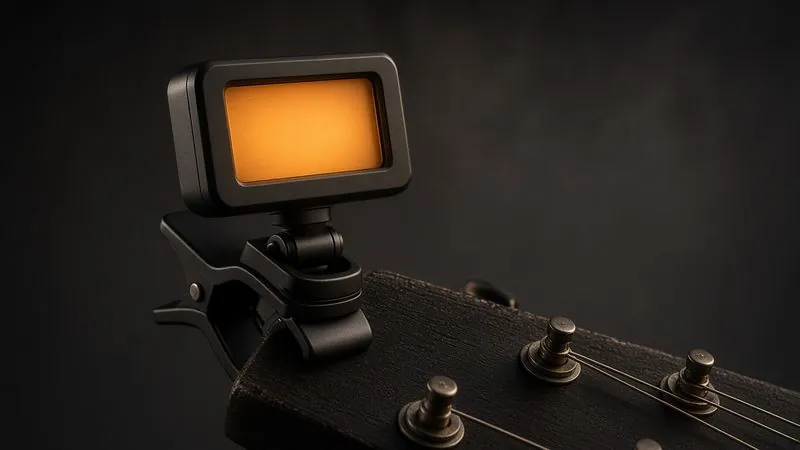
A clip-on tuner (and a spare battery to share).
A capo - songs get called in the singer's key.
A few picks, including a medium or heavy one for strumming loud enough to be heard in a group.
A small notebook to jot down song names, keys and chords.
A strap if you'll be standing, and water.
ILLUSTRATION
Illustration - AI-generated, not a photo of the exact product.
Starter
Snark ST-2 Super Tight Clip-On Tuner
Best for The easy first tuner: clip it on, tune every session - works on acoustic or electric in a noisy room
Clip-on chromatic tunerheadstock clampswiveling display body
Specs: Snark official product page, checked 2026-10-18.
As an Amazon Associate, FretCompare earns from qualifying purchases. Price shown only on Amazon.
Your first jam night, start to finish
The day before: change strings if they're old (new strings need a day to settle), charge or replace your tuner battery, and write 3 songs you can lead on a card with their key and chords.
Arrive 10-15 minutes early. Introduce yourself to the host: "I'm new - is it OK if I sit in and play quietly?" Ask whether there's a slow circle.
Tune away from the circle, then sit at the edge or the outer ring.
First two or three songs: listen and play only the 1 chord when you hear it, or just watch the chord billboard player. Nobody expects more.
Join the rhythm once you hear the pattern - quietly, steady strums or boom-chuck.
When it's your turn to pick a song, choose one from your card. Say "Will the Circle Be Unbroken, in G, it's a 1-4-5", count it in, and sing or play the melody clearly. Or say "pass, thanks" - also fine.
Break offered? Play a simple melody or shake your head and keep strumming.
Between songs: no noodling. Check tuning, chat, learn names.
Leave graciously. Thank the host; if you leave mid-song, wait for it to end.
Afterwards: note the songs that were played and their keys, practise two of them, and go back next week. The second visit is easier than the first.
Common first-night worries
"They're too fast." Play every other strum, or only on beats 1 and 3. Or sit out and listen - it still counts as learning.
"I don't know any of the songs." Most jam songs use the 1, 4 and 5; listen for which one comes next. Our playing by ear guide trains this.
"I made a mistake." Everyone does. Stop for a beat, find the 1 chord, and come back in. Keeping the beat matters more than any single chord.
"I'm the only beginner." Look for others with instruments who aren't playing - they're often new too.
Jam etiquette: the unwritten rules
Listen first. Sit outside the circle for a tune or two, see how it runs, then ask if you can join.
Be in tune - and re-check after any capo change. Tune quietly between songs.
Keep the beat above everything. If you lose your place, stop for a beat or two and come back in on the 1 chord. Don't speed up.
Play quietly until you know the song. If you can't hear the singer or the soloist, you're too loud.
Watch the "chord billboard". Find the guitarist playing clear open chords and copy their left hand.
Don't noodle between songs. That's when people talk and pick the next tune.
When it's your turn to choose, name the song, the key and anything unusual (an odd chord, a 3/4 waltz), then count it in. Pick something everyone can follow.
The singer chooses the key. Capo up or down to match.
Don't play the melody while someone else is soloing or singing (bluegrass) - back them up with rhythm.
Share the spotlight and be encouraging. Everyone was new once.
Songs to know before your first jam
Jam songs vary by region and group, but traditional songs like these come up often in bluegrass and folk circles, and all are public domain. Learn the chords in G, then practise moving them with a capo.
Under a singer: simple, steady rhythm and lower volume. Leave the space between vocal lines empty or add a short bass walk into the next chord.
Under a solo: keep the rhythm going, a little quieter - the soloist relies on you for the beat and the changes.
Chord changes you're unsure of: play just the bass note on beat 1 until you hear the change, then strum.
Fast tempos: strum on beats 2 and 4 only (the "chuck"), and let the bass player carry beats 1 and 3.
Slow songs and waltzes: bass on 1, light strums on 2 and 3 - exactly as on our Amazing Grace page.
Taking (or passing) a solo
In bluegrass jams, players often take turns playing a "break" (a solo) around the circle. You don't have to. When the leader looks at you, either play something simple - the melody, slowly, even just the chord notes - or shake your head, smile and keep strumming. A clear pass is better than a half-started solo. When you're ready, the melody of a simple song played cleanly is a perfectly good break; see our easy bluegrass songs and flatpicking basics.
Signals: changes, endings and "one more time"
Ending: the leader may lift a foot, call "last time" or "going out", or nod. Finish together on the 1 chord.
Who's next: a look or nod passes the break.
Key changes: the leader calls the new key before counting in - capo and re-tune if needed.
Tempo: whoever starts the song sets the speed; don't push it faster.
Bluegrass vs old-time vs folk vs worship jams
Jam type
What's different
Guitar's job
Bluegrass
Songs and instrumentals; players take solos in turn; G, C, D, A, E keys common
Record the session on a phone - listening back teaches timing faster than anything.
Safety notes
Long jams are hard on new fingertips: take breaks and stop if you feel sharp pain or numbness.
Outdoor and festival jams: keep instruments out of direct sun and protect your hearing near loud groups.
FAQ
How good do I need to be to join a jam?
Able to play basic open chords and change between them in time at a moderate tempo. Slow or beginner jams are designed for exactly this level.
How do I find a jam near me?
Check a jam directory such as Jamfinder, ask local music stores, search for your state's bluegrass or folk association, and try Meetup. Look for slow or beginner jams.
What if I don't know the song?
Play quietly, watch the guitarist who knows the chords, and listen for the 1, 4 and 5. It's normal to sit out a tune.
Do I have to take a solo?
No. Shake your head or keep strumming when the break comes to you.
What is the 1-4-5?
The three main chords of a key: in G, they are G (1), C (4) and D (5). Many jam songs use only these three.
What keys do bluegrass jams use?
G, C, D, A and E are common, with capos used to move guitar shapes to the singer's key.
Sources checked
Jamfinder: How to find a bluegrass jam near you (map of recurring jams; finding tips) (checked Oct 21 2026): www.jamfinder.org/find-a-jam/
Wernick Method: Find a Camp or Class (entry requirement: tune, switch G, C, D, A) (checked Oct 21 2026): wernickmethod.org/all-classes
Wernick Method: Finding Jams (Meetup, IBMA, state searches, starting a slower jam) (checked Oct 21 2026): wernickmethod.org/jam-resources/finding-jams
Wernick Method: Bluegrass Jamming Basics (checked Oct 21 2026): wernickmethod.org/bluegrass-jamming-basics
Blue Ridge Music Trails: Jam Etiquette (checked Oct 21 2026): www.blueridgemusicnc.com/listen-and-learn/jam-etiquette/
Valley Bluegrass Music Society: Jam Etiquette (checked Oct 21 2026): valleybluegrasssociety.com/?page_id=58
Not hands-on testing: FretCompare summarises official instructions and published facts. Steps and terms change, so follow the official page if it differs.
Free 7-Day First Chords course - Confirm your email first (Kit sends a confirmation link). Day 1 arrives the next morning (about 9 AM Central), then one short email a day until Day 7: setup, first chords, strumming, a first song. Unsubscribe any time.
 ILLUSTRATION