Guitar Buzz That Stops When You Touch the Strings: Normal or a Fault?
If the hum drops when your hand touches the strings or bridge, your guitar's grounding is usually working as designed. The test below separates normal hum from a cable, wiring or room problem in about five minutes - and flags the few signs that mean stop and get help.
Editorial guide built from manufacturer instructions and specs - not hands-on testing. Product cards link to Amazon; we never show Amazon prices here.
Quick answer
Some hum that drops when you touch the strings is normal: the strings are connected to the guitar's ground, so your body acts as a shield and drains the noise (Yamaha and Seymour Duncan both explain it this way). It is a problem if the hum is loud and does not change when you touch the strings (often a broken ground wire or a bad cable), or if you ever feel a tingle or shock - then stop, unplug, and have the amp and the outlet checked.
Take the lesson finder quiz
Prices last checked: Oct 2026 where a verified price is shown on a card - confirm at checkout. Editorial from published facts, not hands-on testing: How we rate.
Safety first: tingles and shocks
- Feel a tingle or shock from the strings, a microphone or the amp? Stop playing, unplug everything, and do not use that setup until a qualified tech or electrician has checked the amp and the mains wiring. Seymour Duncan notes that grounded strings can increase shock risk if you touch equipment with a polarity fault.
- Never open an amp - amps can hold dangerous voltages even when unplugged.
- Never remove or defeat the ground pin on a plug, or use a ground-lift 'cheater' adapter, to kill hum. It removes a safety path.
- Hum that gets louder when you touch the strings suggests a wiring fault - have a tech look.
Why touching the strings quiets the hum
Pickups pick up more than strings: mains wiring, lights, dimmers and screens all radiate noise. Inside the guitar, a ground wire runs from the controls to the bridge, so the strings are connected to ground. When you touch them, your body joins that ground and shields the guitar, and the hum drops. Yamaha says plainly that this noise cannot be eliminated entirely - only reduced.
Single-coil pickups hum more than humbuckers, which are designed to cancel hum. On many Strat-style guitars the in-between positions (2 and 4) are quieter if the middle pickup is reverse-wound - not every guitar has that.
The 4-step isolation test
- Touch test. Plugged in, volume up, touch the strings or bridge. Hum drops = grounding works (normal). No change at all and the hum is loud = suspect the bridge ground wire or a solder joint (tech job). Louder = wiring fault - stop and see a tech.
- Volume test. Turn the guitar's volume knob to zero. If the noise stops, it is coming in through the guitar or cable. If it stays, it is the amp, a pedal or the power - unplug the cable from the amp entirely to confirm.
- Cable test. Swap in a different, known-good cable and wiggle each end. Crackles, cut-outs or hum that changes when you wiggle = bad cable (see our cables guide). A scratchy jack on the guitar itself is covered in crackling jack or scratchy knob.
- Room test. Turn slowly while playing, move away from computers, monitors, LED dimmers and phone chargers, and switch them off one at a time. If the hum changes with direction or a device, it is interference, not a broken guitar.
Fixes that actually work
- Distance and direction: sit further from screens and dimmers, and turn to the quietest angle.
- Pedals: unplug them and go straight into the amp to compare; a cheap or faulty power supply is a common hum source.
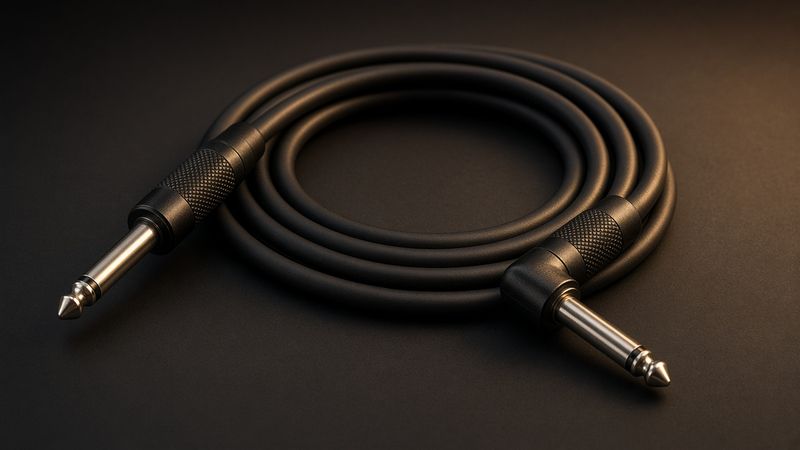
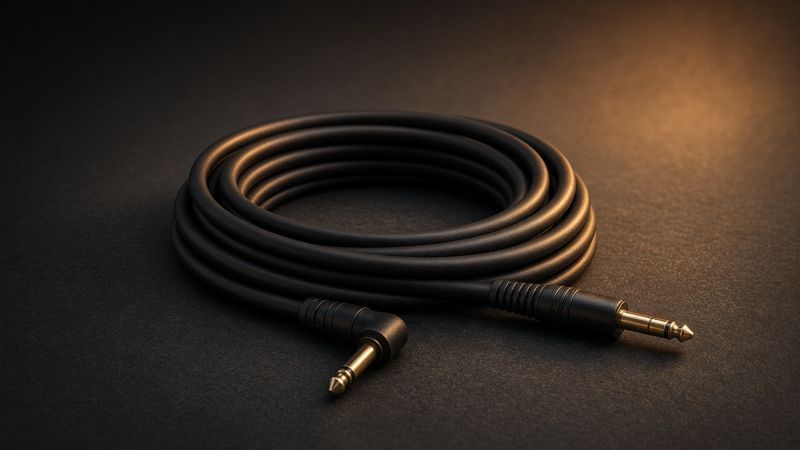
- A good cable: if the cable test failed, replace it. These are catalog cables with maker-verified prices:
Illustration - AI-generated, not a photo of the exact product.
StarterErnie Ball Flex Instrument Cable, 10ft
A budget-friendly main cable that is easy to coil and carry
$22.99
Manufacturer/retailer list price (not an Amazon price): Ernie Ball official cable listing, 10ft - checked 2026-10-18 - checked 2026-10-18. Confirm before buying.
10ft flexible-jacket instrument cable (per Ernie Ball)
Maker/retailer source for the price & specs above (citation, not a buy link): Ernie Ball
See price on Amazon
As an Amazon Associate, FretCompare earns from qualifying purchases. Price shown only on Amazon.
Illustration - AI-generated, not a photo of the exact product.
StarterFender Professional Series Instrument Cable, 10ft
A first good guitar-to-amp cable with published capacitance and lifetime backing
$39.99
Manufacturer/retailer list price (not an Amazon price): Fender official product page, regular price - checked 2026-10-18 - checked 2026-10-18. Confirm before buying.
22 AWG95% OFC spiral shielding8mm jacket26.9 pF/ft capacitancebacked by a lifetime guarantee (per Fender)
Maker/retailer source for the price & specs above (citation, not a buy link): Fender
See price on Amazon
As an Amazon Associate, FretCompare earns from qualifying purchases. Price shown only on Amazon.
Prices last checked: Oct 2026 where a verified price is shown on a card - confirm at checkout. Editorial from published facts, not hands-on testing: How we rate.
Bigger fixes (tech or confident DIY)
- Broken bridge ground wire or a cold solder joint - a short soldering job.
- Cavity shielding (conductive paint or foil) can reduce single-coil hum; it must be grounded properly.
- Hum-cancelling pickups if single-coil hum bothers you - see pickups.
- Noise gates mute noise between notes but do not fix the cause; we do not recommend buying one before running the test above.
FAQ
Is it normal for an electric guitar to buzz until you touch the strings?
Yes, some hum that drops when you touch the strings is normal - your body grounds and shields the guitar. Loud hum that does not change, or any tingle or shock, is not normal.
Why does my guitar buzz when I'm not touching the strings?
The strings and pickups pick up room noise. When you are not touching them, nothing drains that noise to ground through your body. Single coils make it more obvious.
Should I get a shock from my guitar strings?
No. A tingle or shock means stop, unplug and have the amp and the outlet checked by a qualified person. Never remove a plug's ground pin.
Will a better cable stop guitar hum?
Only if the cable is faulty. Run the cable test: swap in a known-good cable and wiggle the ends.
Fix-it guides: Restring a classical - Capo out of tune - Install locking tuners - Loose tuning pegs - Stuck bridge pins - Do you need a string winder? - Best fretboard oil - Hum stops when you touch strings - Strings too hard to press - Install strap locks
Signal chain: Cables - Amps - Pickups - Crackling jack or scratchy knob - Playing without an amp
Sources checked Oct 19, 2026: Seymour Duncan on buzz when not touching the strings, Yamaha musical instrument guide on amplifier noise, Guitar Gear Finder hum FAQ, ProjectGuitar on common wiring faults. Safety: never open an amp; never defeat a ground pin.
 ILLUSTRATION