How to Restring a Classical Guitar (Nylon Strings and the Bridge Knot)
Nylon strings do not use bridge pins or ball ends - they tie onto the bridge and lock around a roller at the slotted headstock. It looks fiddly, but it is one knot repeated six times. Below is the method Taylor and D'Addario describe, in plain steps, plus the settling-in period that catches everyone out.
Editorial guide built from manufacturer instructions and specs - not hands-on testing. Product cards link to Amazon; we never show Amazon prices here.
Quick answer
Change one string at a time. At the bridge, feed the string through from the soundhole side, leave about 3in (7-8cm) out the back, loop it back over and tuck it under itself twice (three times on the plain trebles), with the last twist resting on the back edge of the bridge. At the headstock, thread it through the roller hole, loop it under itself to lock, and wind toward the outside of the roller - Taylor suggests 4-6 wraps. Tune up, stretch, retune, and expect to retune for several days. Never fit steel strings to a classical guitar.
Take the lesson finder quiz
Prices last checked: Oct 2026 where a verified price is shown on a card - confirm at checkout. Editorial from published facts, not hands-on testing: How we rate.
Safety first: never put steel strings on a classical
People search for this, so to be clear: do not fit steel acoustic or electric strings to a nylon-string classical guitar. Classical guitars are built for nylon's much lower tension - many have no truss rod at all, and the bridge and top are braced for nylon. Steel sets pull far harder and can bow the neck, lift the bridge or crack the top. If you want a steel-string sound, you need a steel-string guitar; our nylon vs steel guide explains the difference.
Also: nylon strings are not designed to fit a pin-bridge acoustic either. Buy strings labelled for classical guitar.
What you need
- A classical (nylon) set in the tension you like. Normal tension is the usual starting point; hard tension is louder but firmer under the fingers. Tie-end is standard; ball-end nylon sets exist for players who want to skip the knot - check that your bridge suits them first.
- Cutters, a tuner (clip-on or our browser tuner) and, optionally, a string winder - nylon stretches a lot, so a winder saves real time here (do you need one?).
- A sticky note or piece of card behind the bridge - Taylor's tip to protect the top from the string ends while you work.
Illustration - AI-generated, not a photo of the exact product.
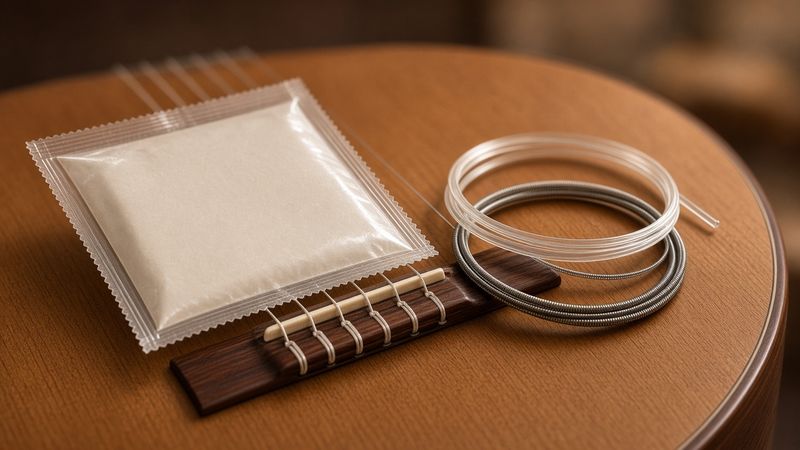
StarterD'Addario EJ45 Pro-Arte Nylon Classical Strings (Normal Tension)
A standard tie-end replacement set for a nylon-string classical guitar - normal tension is D'Addario's best-selling tension
$12.99
Manufacturer/retailer list price (not an Amazon price): D'Addario EJ45 product page - checked 2026-10-19. Confirm before buying.
Tie-end nylon classical setnormal tensionclear nylon treblessilver-plated copper on multifilament nylon basses (per D'Addario)
Maker/retailer source for the price & specs above (citation, not a buy link): D'Addario
See price on Amazon
As an Amazon Associate, FretCompare earns from qualifying purchases. Price shown only on Amazon.
Illustration - AI-generated, not a photo of the exact product.
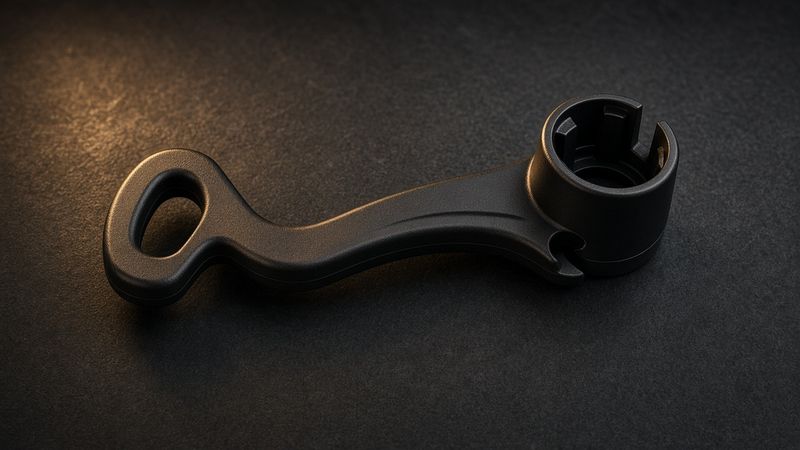
StarterD'Addario Pro-Winder (winder + cutter + pin puller)
The one restringing tool every case should contain
$12.99
Manufacturer/retailer list price (not an Amazon price): D'Addario product page - checked 2026-10-18. Confirm before buying.
String winderhardened-steel string cutter and acoustic bridge-pin puller in one tool (per D'Addario)
Maker/retailer source for the price & specs above (citation, not a buy link): D'Addario
See price on Amazon
As an Amazon Associate, FretCompare earns from qualifying purchases. Price shown only on Amazon.
Prices last checked: Oct 2026 where a verified price is shown on a card - confirm at checkout. Editorial from published facts, not hands-on testing: How we rate.
Step 1: one string at a time
Slacken the old 6th (low E) string until floppy, then unwind it at the roller and untie it at the bridge. Changing one string at a time keeps tension on the neck and, importantly, stops the saddle moving: on many classical guitars the saddle simply sits in its slot and can fall out or shift when all strings are off. If you do take everything off to clean the fretboard, note which way the saddle faces before it moves.
Which end goes where: on the wound bass strings, one end is often more loosely wound and flexible - that end ties at the bridge.
Step 2: tie the bridge knot
- Push the string through the bridge hole from the soundhole side, leaving roughly 3in (7-8cm) sticking out the back.
- Bring the short end back over the top of the tie block and pass it under the main string, making a loop.
- Tuck the end under that loop so it twists around itself. Repeat for a second twist. The plain nylon trebles (G, B, high E) are slippery: give them a third twist.
- Pull the main string toward the headstock so the knot tightens. The final twist should sit on the back edge of the bridge, pinned against the wood, not on top of the tie block - Taylor stresses that this last loop must pass below the back corner of the bridge or the string can slip.
- Leave the tail long enough to reach just past the next hole; the next string will trap it. Taylor and Guitar World both group the three bass strings and the three trebles so each new string captures the previous tail.
If a string slips at the bridge while tuning, the twists are too few or the last loop is riding on top - slacken and re-tie.
Step 3: lock it at the roller
- Line the roller holes up so they all face the same way.
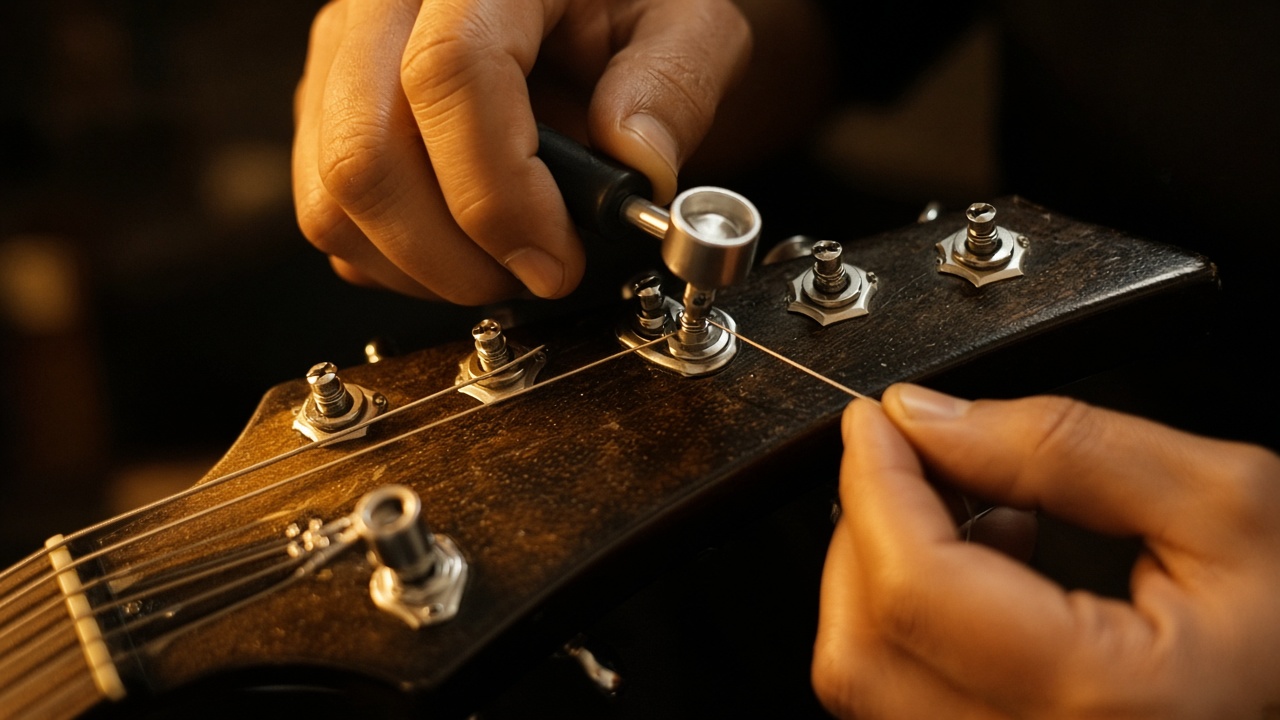
- Pass the string through the roller hole, then bring the end back over the roller and under the main string, and pull it so it bends tight against the roller - this self-lock is what stops slipping. On the slippery trebles, many players pass the end through the hole a second time for extra grip.
- Keep light tension on the string with one hand (Taylor uses an upright fist under the string to set the slack) and wind with the other.
- Wind so the string wraps toward the outside of the roller, over its own tail, without rubbing the edges of the headstock slot. Taylor's guide is a maximum of 4-6 wraps - more wraps are just more nylon to stretch.
Step 4: tune, stretch, retune - then trim
Bring each string up to pitch. Nylon stretches far more than steel, so it will go flat repeatedly. Taylor's method: with all strings near pitch, gently pull each string away from the fretboard along its length with thumb and fingers, retune, and repeat two or three times. Then trim the tails, leaving a few millimetres at the roller and keeping the bridge tail short of the next hole.
Settling in: new nylon strings keep stretching for days - string makers say to expect repeated retuning over the first several days of playing. That is normal, not a faulty set or a broken tuner. If one string still slips after a week, re-check its bridge knot and roller lock.
Common problems after restringing
- Keeps going flat for days - normal nylon stretch-in; keep retuning, stretch gently.
- One string suddenly drops in pitch - a knot slipping at the bridge (add a twist) or a loose roller lock.
- Buzz or rattle - the saddle shifted or a string is out of its nut slot; check both before anything else.
- String ends tapping the top - tails left too long behind the bridge; trim them.
- Tuner feels loose or skips - see loose tuning pegs.
FAQ
Can I put steel strings on a classical guitar?
No. Classical guitars are built for nylon tension; many have no truss rod and a bridge and top braced for nylon. Steel strings can damage the neck, bridge or top.
Why won't my new nylon strings stay in tune?
Nylon stretches a lot when new. Expect to retune repeatedly for several days, stretch the strings gently along their length, and check that each bridge knot has its final twist resting on the back edge of the bridge.
How many times should nylon strings wrap around the roller?
Taylor suggests a maximum of 4-6 wraps, wound toward the outside of the roller over the string's own tail.
Should I change all classical strings at once?
One at a time is safer for beginners: on many classical guitars the saddle is not glued and can move or fall out when all the tension is off.
Which end of a nylon string goes to the bridge?
On bass strings, the end that is more loosely wound and flexible usually goes to the bridge. Plain trebles are the same at both ends.
Fix-it guides: Restring a classical - Capo out of tune - Install locking tuners - Loose tuning pegs - Stuck bridge pins - Do you need a string winder? - Best fretboard oil - Hum stops when you touch strings - Strings too hard to press - Install strap locks
Strings & care guides: Restring an acoustic - Restring an electric - Clean a fretboard - Strings rusting - String keeps breaking - Dull or dead tone - How to store a guitar
Sources checked Oct 19, 2026: Taylor nylon restringing guide and PDF, D'Addario EJ45 product page, SIT Strings classical restring help, Guitar World and Sweetwater classical restringing guides. Safety: nylon-only on classical guitars.
 ILLUSTRATION