Guitar String Keeps Breaking? Where It Snaps Tells You Why
One broken string is bad luck. The same string breaking in the same place is a symptom, and the break point almost always tells you the cause. Before anything else: keep your face away from the strings while tuning up - a string that snaps under tension whips.
Editorial guide built from manufacturer instructions and specs - not hands-on testing. Product cards link to Amazon; we never show Amazon prices here.
Quick answer
Look at where it broke. At the saddle or bridge: a sharp edge or burr, or heavy picking right over it. At the tuner post: a kink or too few wraps. At the nut: a pinching or rough slot. Unravelled at the ball end: a sharp edge on the trem block or ferrule, or a faulty string. During tuning: usually tuning past pitch or to the wrong octave. Fix the cause or the next string goes too.
Take the lesson finder quiz
Prices last checked: Oct 2026 where a verified price is shown on a card - confirm at checkout. Editorial from published facts, not hands-on testing: How we rate.
Breaks while tuning up (the most common beginner cause)
If a new string snaps as you bring it up, check which note you are aiming for. Tuning a high E toward the E above it, or a clip-on tuner reading a neighbouring string, will snap it every time. Use a tuner that shows the note name - our free browser tuner works - and come up to the note slowly. Also check the gauge suits your tuning: a heavier set tuned up a step carries much more tension.
Breaks at the saddle or bridge
Run a fingernail across the saddle where that string sits. A sharp edge, a burr or a groove with a rough lip concentrates stress and cuts strings - the classic 'same string, same place' break, especially on worn or budget saddles. On an acoustic, also check the pin hole and the point where the string bends over the saddle. Fender's setup guidance for its electrics is to gently smooth a burr with a very fine abrasive without changing the saddle's shape (Graph Tech suggests 600-grit and warns against cutting a V-groove), and to put a drop of light oil where the string crosses the saddle when restringing. If you are not confident, or it is an acoustic bone saddle or a deep groove, take it to a tech - removing material is permanent, and it is a quick bench job. Do not use a fret-end file for this - it is shaped for fret ends, not saddle grooves.
Technique matters too: if you dig in hard right next to the bridge, strings fatigue there. Picking a little closer to the neck often helps.
Breaks at the tuner post
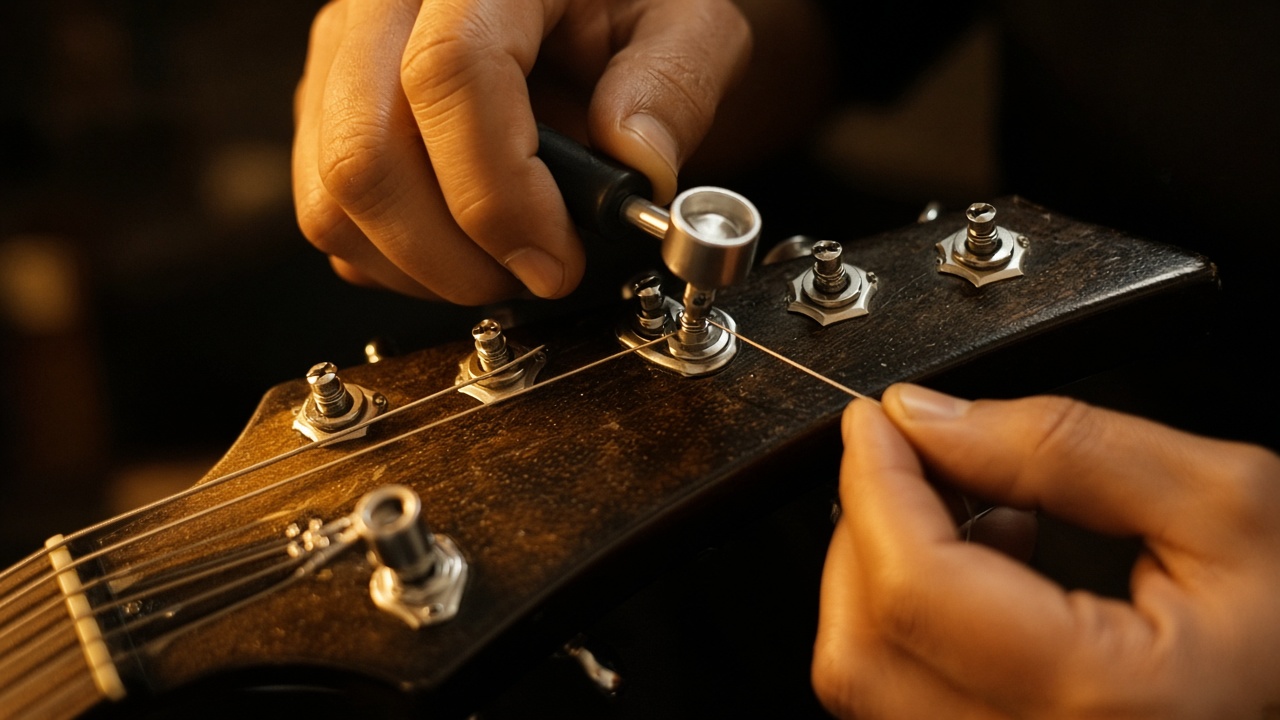
A break at the post means the string was kinked sharply, nicked by a burr on the edge of the post hole (Fender suggests working an old wound string through the hole to smooth it), or had too few wraps and moved. Rewind with about 2-3 wraps on wound strings and 3-5 on plain strings, and do not bend the string back and forth at the post. Full steps: electric or acoustic restringing.
Breaks at the nut, or at the ball end
Nut: a string that pings or sticks while tuning and then breaks at the nut usually has a tight or rough slot. Rubbing soft pencil graphite into the slot is a reasonable home step; recutting slots is tech work (cut too deep and the string buzzes). Ball end: if the winding unravels right by the ball, feel for a sharp edge on the trem block or string-through ferrule and point it out to a tech. A string that fails at the ball end on day one can also simply be faulty - replace it once before blaming the guitar.
Breaks along the neck, or after a few days of hard playing
- Snaps over a fret: a burr or sharp spot on that fret can cut the string - Fender's suggestion is light smoothing; worn or pitted frets are a tech's fret-level job.
- Your pick: heavy, sharp-edged picks wear thin strings faster (Fender lists this too); a worn pick with a jagged edge is worth replacing.
- Bends and alternate tunings: heavy bending and retuning fatigue the same spot; give strings at least three-quarters of a turn on the post even with locking tuners (Ernie Ball's advice) so tension never ends at a kink.
- Brand-new string fails: rare, but it happens - several string makers offer a short warranty for defective strings, so keep the packet.
On the eye-safety worry: Acoustic Guitar's repair column points out that a breaking string usually snaps outward and goes slack rather than whipping at your face - still, keep your face out of line with the strings while tuning up.
Old or rusted strings break first
Corroded strings snap more easily anywhere along their length. If your strings look dark or feel rough, the break is a replacement reminder - see strings rusting fast.
What to buy (only once the cause is fixed)
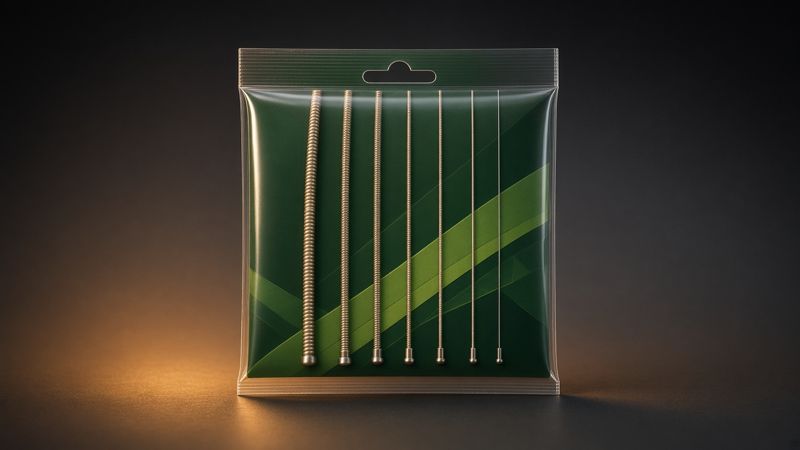
A fresh set in the same gauge as before (so the setup does not change) - the three below are the catalog standards for electric (10-46 and 10-46 Slinky) and acoustic (12-53) - and a winder to make the change quick. No product fixes a burr; that is careful handwork or a tech job, and we would rather tell you that than sell you a file.
Sources checked Oct 19, 2026: Fender on why strings break and its Stratocaster/Telecaster setup guides, StewMac restringing guide, Ernie Ball, Graph Tech, Acoustic Guitar repair column.
Illustration - AI-generated, not a photo of the exact product.
StarterD'Addario EXL110 XL Nickel .010-.046 (electric)
D'Addario's best-selling electric set since 1974 - a safe uncoated default
No list price listed here - we only publish prices we verified on a manufacturer/retailer page. Check the maker and Amazon for current pricing.
Nickel-plated steel wraphex corebright versatile toneuncoated (per D'Addario)
Maker/retailer source for the price & specs above (citation, not a buy link): D'Addario
See price on Amazon
As an Amazon Associate, FretCompare earns from qualifying purchases. Price shown only on Amazon.
Illustration - AI-generated, not a photo of the exact product.
StarterErnie Ball Regular Slinky 2221 .010-.046 (electric)
The classic uncoated electric benchmark - cheaper per pack, change more often
No list price listed here - we only publish prices we verified on a manufacturer/retailer page. Check the maker and Amazon for current pricing.
Nickel-wound electric strings.010-.046uncoated
Maker/retailer source for the price & specs above (citation, not a buy link): Ernie Ball
See price on Amazon
As an Amazon Associate, FretCompare earns from qualifying purchases. Price shown only on Amazon.
Illustration - AI-generated, not a photo of the exact product.
StarterD'Addario EJ16 Phosphor Bronze Light .012-.053 (acoustic)
The standard uncoated acoustic set most guitars ship with
No list price listed here - we only publish prices we verified on a manufacturer/retailer page. Check the maker and Amazon for current pricing.
Phosphor bronze acoustic stringslight .012-.053uncoated
Maker/retailer source for the price & specs above (citation, not a buy link): D'Addario
See price on Amazon
As an Amazon Associate, FretCompare earns from qualifying purchases. Price shown only on Amazon.
Illustration - AI-generated, not a photo of the exact product.
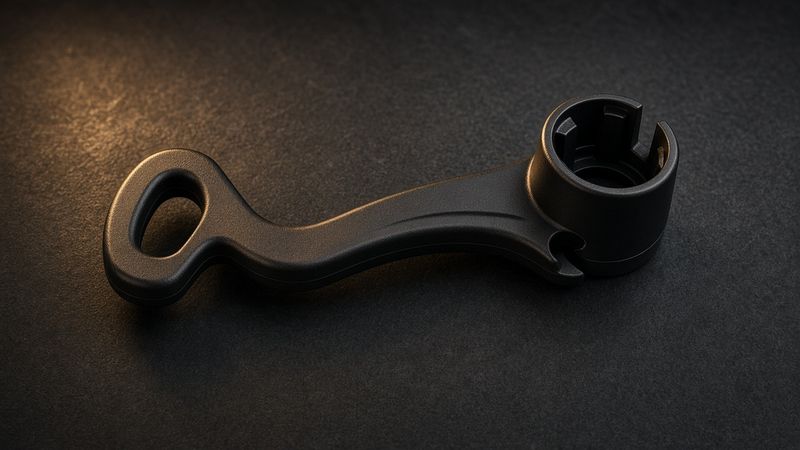
StarterD'Addario Pro-Winder (winder + cutter + pin puller)
The one restringing tool every case should contain
$12.99
Manufacturer/retailer list price (not an Amazon price): D'Addario product page - checked 2026-10-18. Confirm before buying.
String winderhardened-steel string cutter and acoustic bridge-pin puller in one tool (per D'Addario)
Maker/retailer source for the price & specs above (citation, not a buy link): D'Addario
See price on Amazon
As an Amazon Associate, FretCompare earns from qualifying purchases. Price shown only on Amazon.
Prices last checked: Oct 2026 where a verified price is shown on a card - confirm at checkout. Editorial from published facts, not hands-on testing: How we rate.
FAQ
Why does my high E string keep breaking?
Most often tuning past pitch, a sharp edge at the saddle, or a kink at the tuner post. Where it breaks points to the cause.
Why do my strings keep breaking at the bridge?
A sharp burr or worn groove on the saddle, or hard picking right over it. Saddle reshaping is irreversible, so a tech is the right fix.
Why does my string break when tuning?
You are likely aiming for the wrong octave or going past pitch. Tune slowly up to the note with a tuner that shows the note name.
Is it dangerous when a guitar string breaks?
A snapping string can whip toward your face. Keep your face away from the strings while tuning up and point cut ends away from your eyes when trimming.
Should I file my saddle myself?
Not unless you have done it before. It removes material permanently; a tech can smooth a burr quickly.
Strings & care guides: Restring an acoustic - Restring an electric - Clean a fretboard - Strings rusting - String keeps breaking - Dull or dead tone - How to store a guitar - Won't stay in tune - Fret buzz fix
 ILLUSTRATION