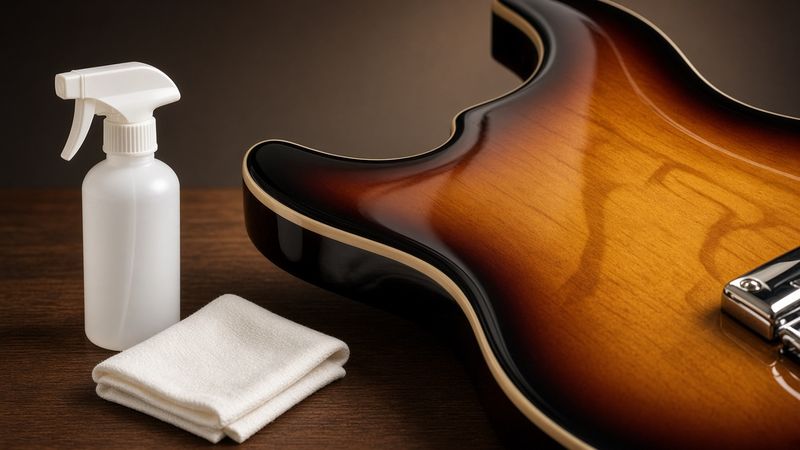
How to Clean a Guitar (Body and Finish) Without Damaging It
Most guitars need nothing more than a dry cloth after you play. Cleaners and polish are for when that is not enough - and the right one depends on your finish. This page covers the body, neck back and hardware; for the fretboard see how to clean a fretboard.
Editorial guide built from manufacturer instructions and specs - not hands-on testing. Product cards link to Amazon; we never show Amazon prices here.
Quick answer
Wipe the guitar with a soft dry microfiber cloth after every session. For grime on a gloss finish, spray a guitar-specific cleaner onto the cloth (not the guitar), wipe, then buff dry. Never polish a satin or matte finish - just dry wipe. If you don't know the finish, treat it as nitro: test any product in a hidden spot. Never use household cleaners like glass cleaner, all-purpose spray or anything with silicone or ammonia.
Take the lesson finder quiz
Prices last checked: Oct 2026 where a verified price is shown on a card - confirm at checkout. Editorial from published facts, not hands-on testing: How we rate.
Step 1: identify the finish
| Finish | How to tell | How to clean |
|---|
| Gloss polyester/polyurethane (most modern guitars) | Shiny, hard, plastic-like | Dry cloth; guitar cleaner/polish for grime |
| Satin or matte | Dull, low sheen | Soft dry cloth only - polish can make satin patchy and shiny (PRS, Gretsch and Premier Guitar all warn against it) |
| Nitrocellulose lacquer | Often vintage, reissue or high-end; the maker's spec sheet says nitro | Dry cloth; only products the maker says are nitro-safe; avoid contact with rubber, vinyl and some foams |
Check the maker's spec page if you are unsure. PRS's advice: when in doubt, treat it as nitro.
Step 2: clean it, step by step
- Take off jewellery, belt buckles and anything that scratches.
- Dust first with a dry microfiber cloth so you don't grind grit into the finish.
- For fingerprints or sweat film on gloss: spray a little cleaner onto the cloth, not the guitar (keeps it out of pickups, electronics and the soundhole).
- Wipe in small sections, working away from pickguard edges so liquid doesn't creep underneath.
- Buff dry with a clean part of the cloth.
- Back of the neck: dry wipe or a barely damp cloth; dry immediately. Many players prefer an unpolished neck so the hand doesn't stick.
- Hardware: dry cloth. Wipe sweat off bridges and saddles after playing to slow corrosion.
What never to use
- Glass cleaner, ammonia, all-purpose cleaners and furniture polish with silicone (Fender and Premier Guitar both warn against these).
- Abrasive pads, paper towels with grit, or rubbing compound - unless you're intentionally doing finish work.
- Lemon oil or fretboard oil on the body finish - those are for unfinished rosewood/ebony boards. See best fretboard oil.
- Water dripping anywhere - especially near pickups, controls or an acoustic's soundhole.
Products that directly do the job
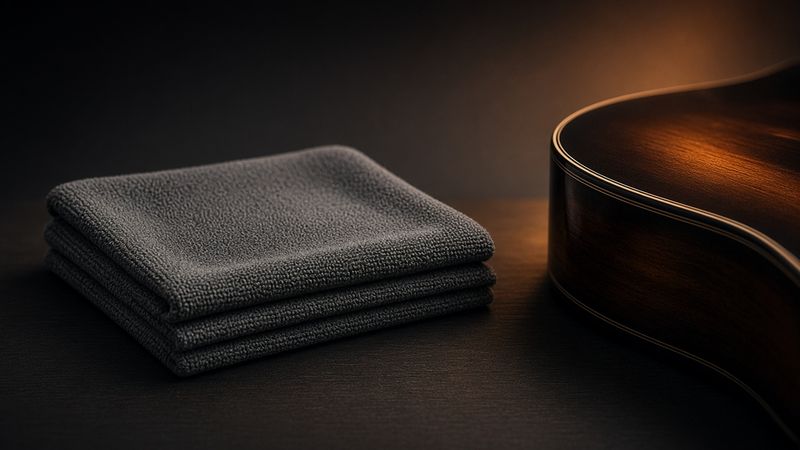
- D'Addario microfiber cloth - the only thing most guitars need, on every finish.
- Dunlop 654C Formula 65 Polish & Cleaner with cloth - for gloss finishes with grime or fingerprints. Dunlop does not state nitro compatibility on its product page, so do not use it on satin, and test in a hidden spot on nitro.
Illustration - AI-generated, not a photo of the exact product.
StarterD'Addario Micro-Fiber Polishing Cloth
The cheapest care habit there is: wipe strings and body after playing to slow corrosion and grime
No list price listed here - we only publish prices we verified on a manufacturer/retailer page. Check the maker and Amazon for current pricing.
Microfiber polishing cloth for guitar finishes and strings wipe-downs
Maker/retailer source for the price & specs above (citation, not a buy link): D'Addario
See price on Amazon
As an Amazon Associate, FretCompare earns from qualifying purchases. Price shown only on Amazon.
Illustration - AI-generated, not a photo of the exact product.
StarterDunlop 654C Formula 65 Guitar Polish & Cleaner with Cloth
Gloss poly/polyurethane finishes that need more than a dry wipe - smudges, sweat film, fingerprints. Not for satin/matte finishes; test first on nitro.
$11.54
Manufacturer/retailer list price (not an Amazon price): Jim Dunlop product page - checked 2026-10-19. Confirm before buying.
Formula 65 polish/cleaner spray plus polishing cloth (per Dunlop). Dunlop does not state nitrocellulose compatibility on the product page.
Maker/retailer source for the price & specs above (citation, not a buy link): Dunlop
See price on Amazon
As an Amazon Associate, FretCompare earns from qualifying purchases. Price shown only on Amazon.
Prices last checked: Oct 2026 where a verified price is shown on a card - confirm at checkout. Editorial from published facts, not hands-on testing: How we rate.
Safety and finish notes
- Vintage nitro with checking or patina: clean gently with a dry cloth - polish can harm the look you value. Get a tech's advice before restoring.
- Keep nitro guitars away from rubber stand padding, vinyl and some strap materials; see stands & hangers.
- Keep any spray away from eyes; ventilate if using solvent-based products.
FAQ
What can I use to clean my guitar body?
A soft dry microfiber cloth for routine cleaning. For grime on a gloss finish, a guitar-specific cleaner sprayed onto the cloth. Avoid household cleaners.
Can I use Windex on a guitar?
No. Glass cleaners contain ammonia or other chemicals that guitar makers warn can damage finishes.
Should I polish a satin guitar?
No. Polish can make a satin finish shiny and patchy. Use a soft dry cloth only.
How often should I clean my guitar?
Dry wipe after every session. Use cleaner only when the dry wipe doesn't remove fingerprints or grime.
Is guitar polish safe for nitro finishes?
Only if the maker says so. When in doubt, use a dry cloth or test in an inconspicuous spot first.
More fix-it and buying guides: Guitars for small hands - Your first pedal - Travel guitars - Clean a guitar body - Are wall hangers safe? - Floyd Rose won't stay in tune - Put on a strap - Sounds bad even when tuned - Acoustic guitar crack - Do you need a case?
Strings & care guides: Restring an acoustic - Restring an electric - Clean a fretboard - Strings rusting - String keeps breaking - Dull or dead tone - How to store a guitar
Sources checked Oct 19, 2026: PRS guitar care guide, Gretsch finish care, Fender cleaning guidance, Premier Guitar cleaning feature, MusicNomad cleaning steps, Jim Dunlop Formula 65 product page, current top Google guides. Safety: no household cleaners; treat unknown finishes as nitro.
 ILLUSTRATION