Capo Makes Your Guitar Sound Out of Tune? The Fixes in Order
A capo nearly always pushes strings slightly sharp - the question is how much. Placement and pressure fix most of it for free; tuning with the capo on fixes the rest. Only if that fails is it the capo itself or the guitar's setup.
Editorial guide built from manufacturer instructions and specs - not hands-on testing. Product cards link to Amazon; we never show Amazon prices here.
Quick answer
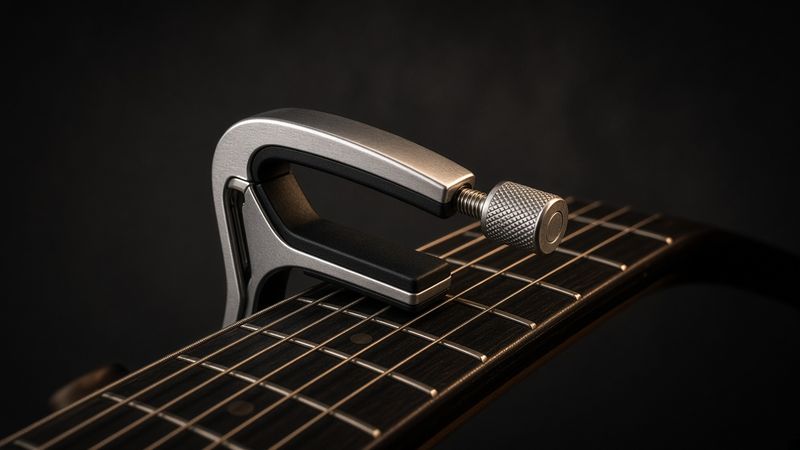
Put the capo right behind the fret - nearly touching it, straight across, not on top of it or halfway between frets - and use the least pressure that stops buzzing. Then tune with the capo on. If it still sounds sharp, check your guitar's intonation; a spring capo with fixed pressure may simply be too strong for your neck, which is where an adjustable-tension capo helps.
Take the lesson finder quiz
Prices last checked: Oct 2026 where a verified price is shown on a card - confirm at checkout. Editorial from published facts, not hands-on testing: How we rate.
Why a capo pulls strings sharp
To make a note, the string is pressed down to a fret. Any extra force, or pressing the string further than it needs to travel, stretches it a little - and a stretched string goes sharp. D'Addario puts it simply: too little pressure buzzes, too much puts the strings out of tune. Andertons adds three things that make it worse: high action (the string travels further), tall jumbo frets (same), and capos that squeeze or pull the strings sideways as they go on. Thicker strings usually show it most.
Fix 1: placement (free, and fixes the most)
- Place the bar directly behind the fret, on the headstock side - Gibson's guidance is just behind and nearly touching the fret, but not on top of it. On top of the fret mutes and buzzes; far back stretches the strings sharp.
- Keep the capo straight, square to the strings. A crooked capo pulls some strings more than others (Gibson flags this as an intonation problem).
- After clamping, look along the strings: they should still be evenly spaced and parallel. If the capo dragged them sideways, open it and re-seat it straight down rather than sliding it on.
Fix 2: pressure
Use the minimum pressure that gives clean notes. With a screw or adjustable-tension capo, loosen until a string just buzzes, then tighten slightly past that. With a fixed spring capo you cannot adjust it - Andertons' test is to pluck a note and ease the capo's grip slightly (not enough to buzz): if the pitch drops, the spring was pushing you sharp.
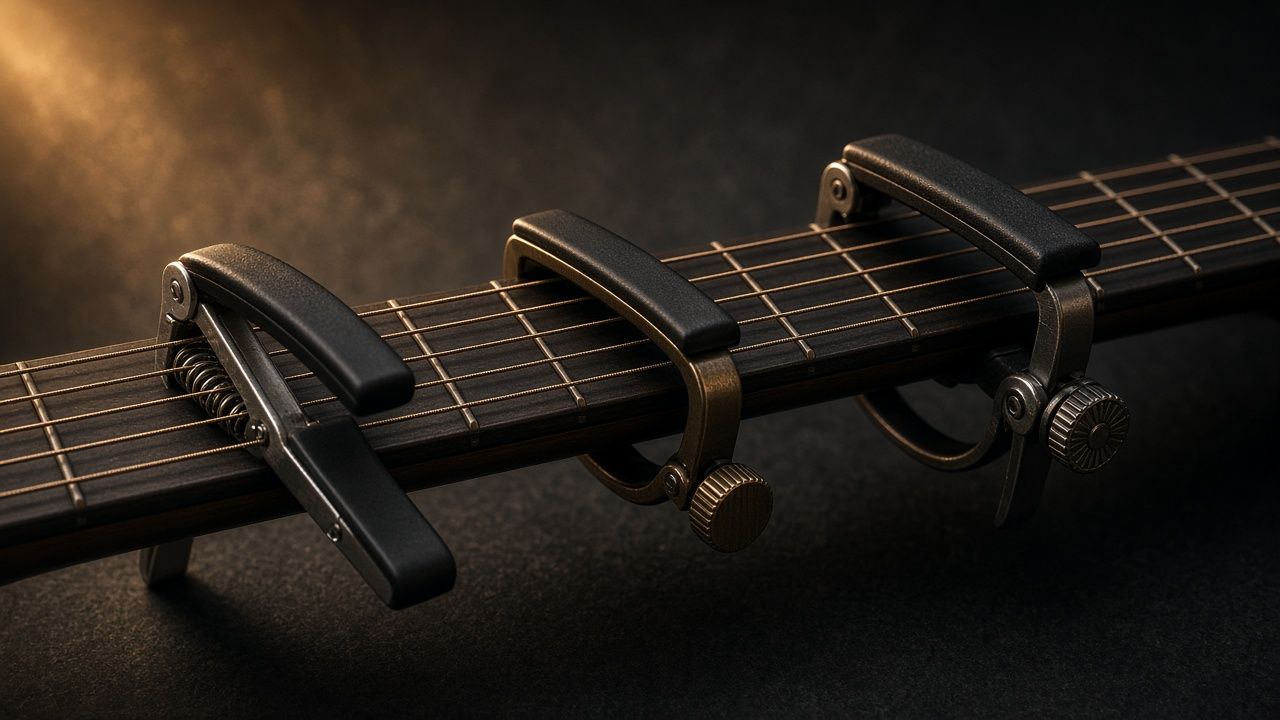
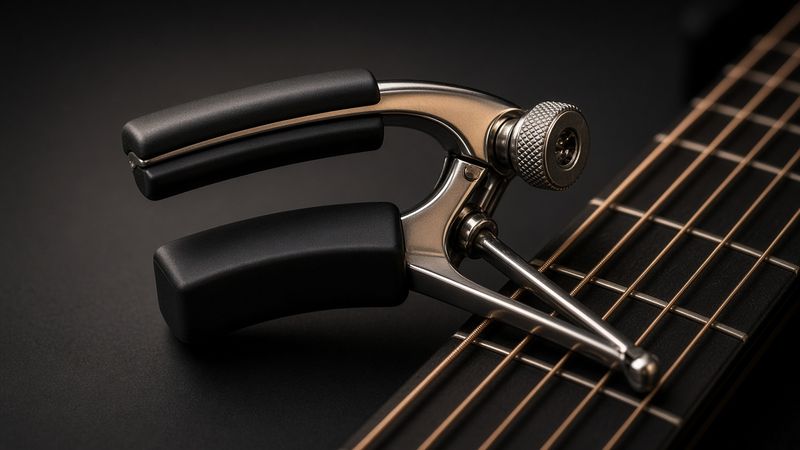
If a fixed spring capo consistently pushes your guitar sharp, that is the spring meeting your neck. The fix is a different capo, not more technique - which is the case for these two adjustable designs from our catalogue:
Illustration - AI-generated, not a photo of the exact product.
SeriousShubb S1 Deluxe Capo (Stainless Steel, Steel-String)
The buy-once adjustable capo: dial the tension to your neck so strings are pressed like a fingertip, not crushed sharp
No list price listed here - we only publish prices we verified on a manufacturer/retailer page. Check the maker and Amazon for current pricing.
Solid stainless steeladjustable closing tension with roller designfits most steel-string acoustics and electrics (per Shubb)
Maker/retailer source for the price & specs above (citation, not a buy link): Shubb
See price on Amazon
As an Amazon Associate, FretCompare earns from qualifying purchases. Price shown only on Amazon.
Illustration - AI-generated, not a photo of the exact product.
Step-upD'Addario NS Capo Pro (PW-CP-02)
Adjustable tension lets you use only as much pressure as needed - helps tuning stay truer than a hard spring clamp
No list price listed here - we only publish prices we verified on a manufacturer/retailer page. Check the maker and Amazon for current pricing.
Screw-adjustable (micrometer tension) capoaircraft-grade aluminum (per D'Addario NS capo line)
Maker/retailer source for the price & specs above (citation, not a buy link): D'Addario
See price on Amazon
As an Amazon Associate, FretCompare earns from qualifying purchases. Price shown only on Amazon.
Prices last checked: Oct 2026 where a verified price is shown on a card - confirm at checkout. Editorial from published facts, not hands-on testing: How we rate.
Fix 3: tune with the capo on
Fit the capo, then touch up the tuning - Gibson, Guitar Player and most teachers agree. Tuning open and then clamping means tuning to a state you are about to change. Remember that the tuner now reads the capo'd notes: with a capo at the 2nd fret, standard tuning reads F#-B-E-A-C#-F#. Move the capo and check again; the effect is usually bigger higher up the neck where frets are closer together.
Many players tune open, put the capo on and make a small correction, then remove the capo and correct again - fine as long as you finish tuned for how you will play. A clip-on tuner that stays on the headstock makes this quick:
Illustration - AI-generated, not a photo of the exact product.
Step-upD'Addario Micro Universal Tuner (NS Micro)
Tiny and discreet: lives on the headstock, readable from front or behind - the always-there tuner
$22.99
Manufacturer/retailer list price (not an Amazon price): D'Addario product page (re-checked 2026-10-18) - checked 2026-10-18. Confirm before buying.
Clip-on headstock tunerreversible multi-color displaydual-swivel mount410-480Hz calibration range (per D'Addario)
Maker/retailer source for the price & specs above (citation, not a buy link): D'Addario
See price on Amazon
As an Amazon Associate, FretCompare earns from qualifying purchases. Price shown only on Amazon.
Prices last checked: Oct 2026 where a verified price is shown on a card - confirm at checkout. Editorial from published facts, not hands-on testing: How we rate.
Fix 4: it might be the guitar, not the capo
Intonation check (Andertons): tune the open string, then play the same string at the 12th fret. If the fretted note is noticeably sharp or flat compared with the open string (an octave higher), the guitar's intonation is off, and a capo makes every chord a little worse. On electrics with adjustable saddles, intonation is a routine setup step; on acoustics it usually means a saddle adjustment by a tech.
High action makes capos pull sharper because the string travels further - see high action fix. Old strings play out of tune everywhere; fresh strings first.
Quick symptom table
| Symptom | Likely cause | Fix |
|---|
| Everything slightly sharp | Too much pressure or capo too far behind the fret | Move it closer to the fret; reduce pressure if adjustable |
| One or two strings sharp | Capo crooked or dragged strings sideways | Re-seat straight down and square |
| Buzzing on one string | Capo sitting on the fret, or bar not matching the neck curve | Move behind the fret; try a capo that suits your board's radius |
| Sharp higher up the neck | Intonation or high action | Check intonation; setup |
| Fine at fret 2, worse at fret 7 | Normal - tolerance is tighter higher up | Retune at each position |
FAQ
Why does my guitar sound out of tune with a capo?
Usually the capo is too far behind the fret or clamping too hard, which stretches the strings sharp. Move it right behind the fret, reduce pressure if you can, and tune with it on. If it persists, check intonation.
Should you tune a guitar with the capo on?
Yes - tune or at least touch up the tuning after the capo is on, at the fret you will play. The tuner will show the capo'd notes, not E-A-D-G-B-E.
Are adjustable capos better for tuning?
They let you set just enough pressure for your guitar, which tends to disturb tuning less than a fixed spring that may be stronger than your neck needs.
Does a capo damage the guitar?
Used normally, no. Remove it when you finish playing rather than leaving it clamped for long periods.
Fix-it guides: Restring a classical - Capo out of tune - Install locking tuners - Loose tuning pegs - Stuck bridge pins - Do you need a string winder? - Best fretboard oil - Hum stops when you touch strings - Strings too hard to press - Install strap locks
Capo help: Capos - Best capos for beginners - Spring vs adjustable - Kyser vs Shubb - Do you need a capo? - Won't stay in tune
Sources checked Oct 19, 2026: Gibson and D'Addario capo how-tos, Andertons on capo intonation, Guitar Player capo FAQ, Capo & Cable capo guide.
 ILLUSTRATION