In Tune at the Nut, Out of Tune Up the Neck? Fix Your Intonation
Your tuner says every open string is perfect, yet chords halfway up the neck sound sour and a melody drifts sharp the higher you play. That is intonation - the guitar disagreeing with itself along its own neck - and on most electrics it is a careful, reversible fix you can do with a tuner and patience.
Editorial guide from manufacturer facts and standard setup practice - not hands-on testing. Intonation is a compromise by design; this page aims for honestly close, not laboratory perfect.
Quick answer
Put fresh strings on first - dead strings physically will not intonate - then do the 12th-fret test: tune the string open, compare the harmonic at the 12th fret with the note fretted at the 12th. If the fretted note is sharp, move that string's saddle back (lengthen the string); if it is flat, move the saddle forward (shorten it). Small moves, re-tune after each, one string at a time. That is the whole adjustment; everything below is doing it carefully and spotting the impostors.
Take the gear-fit quiz
Prices last checked: Oct 2026 where a verified price is shown on a card - confirm at checkout. Editorial from published facts, not hands-on testing: How we rate.
Step 0: old strings first - intonation cannot be set on dead strings
Before any screwdriver comes out: how old are your strings? A worn string has flat spots, corrosion and uneven mass along its length, so it vibrates falsely and cannot be intonated by any saddle position - players chase their tails for an hour on a set that needed changing anyway. If the strings are dull, rough, or older than the timeline in our string-change guide, change them now, stretch the new set in properly (the pull-and-retune method is on our won't-stay-in-tune page), and only then test. Same rule after a gauge change: a different gauge is a different tension and diameter, and the saddles were set for the old set - run the string gauge finder thinking first, expect to re-intonate after.
Step 1: the 12th-fret harmonic-vs-fretted test, step by step
You need a tuner you trust at two pitches - our free browser tuner works at home, and the clip-on below earns its keep by living on the headstock for the dozen re-tunes this job takes (what clip-on accuracy figures do and do not promise is covered honestly in our clip-on tuner accuracy guide). For each string, in order: 1. Tune the open string exactly. 2. Touch the string feather-lightly directly above the 12th fret wire and pluck - that bell-like note is the harmonic; check it reads in tune (it should, since it divides the open string in half). 3. Now fret the same string at the 12th fret with your normal playing pressure and pluck again. 4. Compare: fretted note sharp of the harmonic = the string is effectively too short; fretted flat = too long; agreement = leave that string alone and move on. Two technique traps fake a bad reading: pressing extra hard bends the fretted note sharp (use your real playing pressure, not a death grip), and a capo clamped behind the fret for the test adds its own squeeze - test with a finger.
Step 2: the saddle rule - sharp goes back, flat comes forward
Here is the direction logic, stated once and worth memorising exactly: fretted note sharp → move the saddle BACK, away from the neck, lengthening the string. Fretted note flat → move the saddle FORWARD, toward the neck, shortening it. (Why it works: a longer sounding length lowers the fretted pitch relative to the open string, a shorter one raises it - verify it against your own tuner on the first move and the logic will never feel backwards again.) On most electrics each string's saddle moves with a small screw at the back of the bridge; the saddle and truss hex sizes on common bridges are in the tool cards below. Work one string at a time, move a little - a quarter to half a turn is a sensible increment - slacken or re-tune the string to pitch after every move, then repeat the harmonic-vs-fretted comparison. Expect two to four cycles per string. Write down what you did; intonation day is no day for relying on memory.
Acoustic guitars: check honestly, adjust humbly
Most acoustics have a single fixed (often compensated) saddle with no per-string adjustment, so Step 2 becomes: run the test, learn which strings disagree and by how much, and then make an adult decision. Small disagreements on a healthy acoustic with fresh strings are the instrument's built-in compromise, audible mainly to a tuner. A string that is wildly out, or several strings out in the same direction, points at saddle placement or a saddle that has leaned or worn - that is a tech's compensated-saddle or saddle-position job, and filing an acoustic saddle at home to chase intonation is how a reversible question becomes a parts order. Our high-action page covers the acoustic saddle's other job (height) and its irreversibility warnings; the same conservatism applies here.
False causes: when it is not the saddles at all
Chords can sound out of tune up the neck for reasons saddles never caused. Pressing too hard - beginners especially, on tall frets and light strings - bends every fretted note sharp; test yourself by fretting one note with the lightest touch that sounds it cleanly and watch the tuner recover. A capo squeezed mid-fret does the same thing (our capos guide covers placement). Old strings, covered above, remain the champion impostor. And a guitar in tune everywhere except one area of the neck may have a worn or lifted fret locally - that is the one-fret territory of our fret buzz triage, and a tech's fret level, not a saddle move. Finally, perspective: a fretted instrument is tempered, so some thirds in some chords will always beat slightly against a tuner-perfect open string. Intonation done honestly gets you close everywhere; it does not repeal the physics of frets, and any page promising perfect is selling something.
The short product list (a tuner, and saddle screws only)
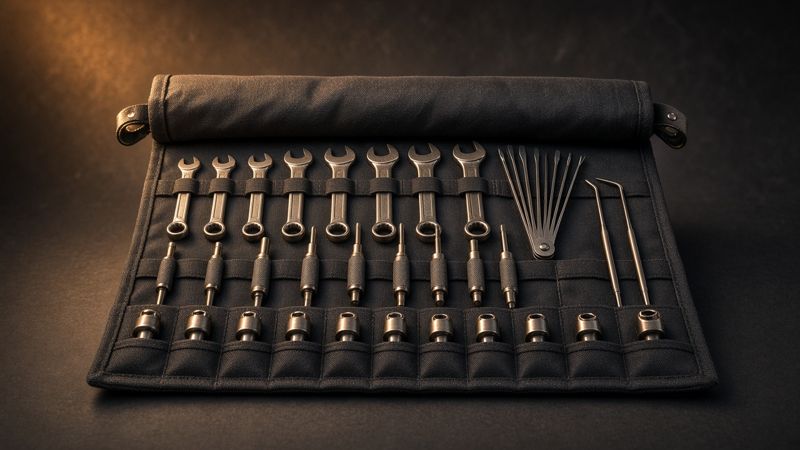
This page's real tool is measurement. The NS Micro below is the verified way to run the harmonic-vs-fretted comparison string after string without putting the guitar down; the maintenance kit and wrench set appear only because saddle and some truss screws need exact-fit small hex keys, and they get the same honest either/or framing as on our fret buzz page - own one route, not both. Strings are in the catalog on the strings guide, Amazon-check only, and Step 0 already told you when you need them. Nothing here is strobe-grade and nothing claims to be.
Illustration - AI-generated, not a photo of the exact product.
Step-upD'Addario Micro Universal Tuner (NS Micro)
Tiny and discreet: lives on the headstock, readable from front or behind - the always-there tuner
$22.99
Manufacturer/retailer list price (not an Amazon price): D'Addario product page (re-checked 2026-10-18) - checked 2026-10-18. Confirm before buying.
Clip-on headstock tunerreversible multi-color displaydual-swivel mount410-480Hz calibration range (per D'Addario)
Maker/retailer source for the price & specs above (citation, not a buy link): D'Addario
See price on Amazon
As an Amazon Associate, FretCompare earns from qualifying purchases. Price shown only on Amazon.
Illustration - AI-generated, not a photo of the exact product.
SeriousD'Addario Guitar Maintenance Kit
One kit for restringing, cleaning and basic setup checks
$99.99
Manufacturer/retailer list price (not an Amazon price): D'Addario product page - checked 2026-10-18. Confirm before buying.
Pro-Winderneck cradle/headstandmulti-toolstring height gaugefret polishing systemmat and case (per D'Addario)
Maker/retailer source for the price & specs above (citation, not a buy link): D'Addario
See price on Amazon
As an Amazon Associate, FretCompare earns from qualifying purchases. Price shown only on Amazon.
Illustration - AI-generated, not a photo of the exact product.
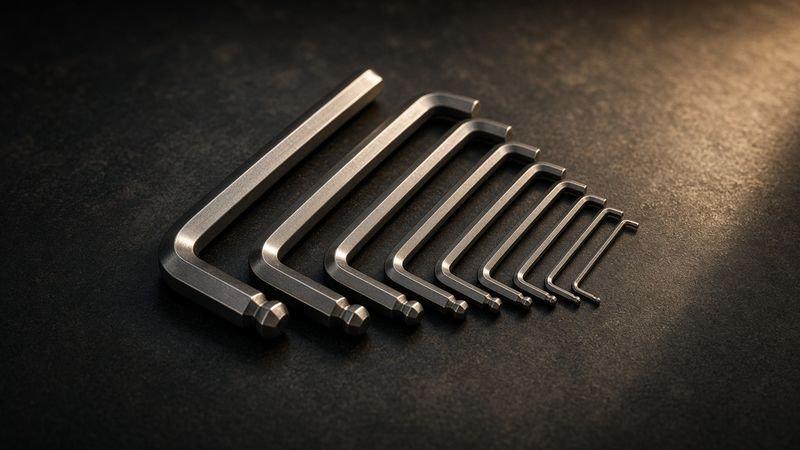
Step-upBondhus 20199 Balldriver L-Wrench Double Pack (BLX22, 22-piece)
The cheaper alternative to a full maintenance kit for saddle-height and careful setup checks: .050in and 1.5mm cover saddle screws, 1/8in (Fender USA truss), 3/16in (Fender Mexico truss) and 4mm/5mm (many import and Squier truss rods) cover the truss sizes guitarists actually meet. Honest limits: ball ends are for access at low torque - use the flat short end, fully seated, for a truss rod; and most Gibsons adjust with a 5/16in socket, not a hex key, so this set does not help there.
No list price listed here - we only publish prices we verified on a manufacturer/retailer page. Check the maker and Amazon for current pricing.
Ball-end L-wrenchesProTanium steelmade in USAlifetime warranty (per Bondhus). Metric 1.522.53456810mm + SAE .0501/165/643/327/641/89/645/323/167/321/45/163/8in; ball ends enter at up to 25 degrees (per Bondhus)
Maker/retailer source for the price & specs above (citation, not a buy link): Bondhus
See price on Amazon
As an Amazon Associate, FretCompare earns from qualifying purchases. Price shown only on Amazon.
Prices last checked: Oct 2026 where a verified price is shown on a card - confirm at checkout. Editorial from published facts, not hands-on testing: How we rate.
FAQ
How do I fix my guitar intonation?
Fresh strings first - old strings will not intonate. Tune a string perfectly open, compare its 12th-fret harmonic with the fretted 12th-fret note on a tuner, then move that string's saddle: fretted note sharp means move the saddle back (lengthen), fretted note flat means move it forward (shorten), re-tuning after every small move until harmonic and fretted note agree.
Why is my guitar in tune open but out of tune up the neck?
That mismatch is exactly what intonation describes. Fretting stretches a string slightly sharp, and makers compensate by making the string's sounding length a little longer than the scale on paper - set at the saddle. If the saddle position is wrong for that string (or the strings are old, or the gauge changed), open and fretted notes disagree more the higher you play.
Which way do I move the saddle for intonation?
Use the sentence: sharp goes back, flat comes forward. If the fretted 12th-fret note is sharp of the harmonic, move the saddle back, away from the neck, to lengthen the string. If the fretted note is flat, move the saddle forward, toward the neck, to shorten it. Small moves, re-tune, re-check - per string.
Can a clip-on tuner set intonation?
It can get a first guitar honestly close, which is what most beginners need: it reads the harmonic and fretted note well enough to make small saddle corrections. It is not a strobe tuner and we do not claim strobe accuracy for it - read our clip-on tuner accuracy page for what the numbers on the box do and do not mean.
Why won't my guitar intonate even after adjusting?
Usually one of three things: the strings are too old (replace them - this fixes more 'won't intonate' cases than any screw), the gauge changed and the saddles were set for the old tension and thickness, or a worn fret or nut is defeating the geometry. On acoustics, a fixed saddle that is in the wrong place is a tech's compensated-saddle job, not a home filing project.
Setup hub: Fret buzz fix - High action fix - Fret sprout fix - Won't stay in tune (drifts over minutes? that page, not this one) - Tuners - String gauge finder
 ILLUSTRATION