Guitar Strings Too High? Why Your Action Feels Like Hard Work
If pressing a chord feels like a grip workout and your fingers ache by the second song, your action - the height of the strings above the frets - may be too high. This page finds which of the three height adjustments is actually yours before you turn anything, because two of them are forgiving and one of them is permanent.
Editorial guide from manufacturer facts and standard setup practice - not hands-on testing. No universal action measurements are given: compare your guitar against your maker's published spec for your model.
Quick answer
High action has three separate causes - neck relief, saddle height, and nut height - and they are checked in that order. Relief you assess with a capo-and-tap test (no tools); saddle height is the true action adjustment (screws on an electric, easily reversed; sanding on an acoustic, not reversible); nut height is a tech job for beginners. The truss rod is not an action knob: it sets the neck's curve, and using it to chase string height is how beginners trade hard-to-play for buzzy. Noisy instead of hard to press? That is the opposite problem - go to our fret buzz fix.
Take the gear-fit quiz
Prices last checked: Oct 2026 where a verified price is shown on a card - confirm at checkout. Editorial from published facts, not hands-on testing: How we rate.
Is my action too high? Check before you adjust
Start by looking, not turning. Sight along the neck: strings should arc gently above the frets, not ski-jump away from them. Then do the standard relief check, which needs no measuring tools: hold a string down at the first fret (a capo helps) and where the neck meets the body, and look at the gap between that string and a middle fret - there should be a small visible gap, not a string lying flat on the fret and not a canyon. Finally, compare the string height at the 12th fret against the spec your guitar's maker publishes for your model. We will not give you a number and call it universal, because scale lengths, fret sizes and playing styles differ too much for one figure to be honest; "check your maker's spec" is the measurement advice that cannot mislead you. If everything measures in-spec and it still feels like hard work, the cause may be string gauge, not setup - run the string gauge finder before reaching for tools.
Cause 1: neck relief - and why the truss rod is not an action knob
Relief is the slight forward bow built into a neck under string tension. Too much relief lifts the strings through the middle of the neck - the classic "high at the 12th fret, fine at the first" complaint. Too little (or a back-bow) does the opposite and buzzes. The truss rod's job is only this curve. If your relief check shows a big gap mid-neck, a small truss adjustment may be part of the fix - and here the discipline from our buzz page applies in full: exact snug key or socket only (never a close metric-for-imperial swap), flat end fully seated, strings loosened where your maker instructs, 1/8-turn increments, re-check between turns, and stop immediately if the nut will not turn freely. A truss rod forced against resistance can snap, and a snapped rod is a neck-killing repair. Many Gibson-style nuts are sockets, not hex keys. If the relief check looks normal, leave the rod alone entirely: your problem is a saddle or a nut, and the next two sections are yours.
Cause 2: saddle height - the real action adjustment
Saddles set the string height at the bridge end, and this is where action is genuinely adjusted. On most electrics each saddle has small height screws: raise or lower in small, even moves, keep the saddle level, re-tune, and play-test - it is reversible, so it is the beginner-safe place to learn, with the hex keys below covering the common saddle sizes. On an acoustic the saddle is usually a bone or synthetic strip in the bridge: lowering action means sanding its base, and sanding is irreversible - material you remove does not come back, and a saddle taken too low must be replaced or shimmed. The conservative acoustic order is: confirm relief is right first, confirm the nut is not the problem, measure twice, remove a little, string up, and play before removing more. If that sentence made you nervous, it should - an acoustic saddle is a fine first tech job and a poor first experiment, especially on a guitar you might still return.
Cause 3: nut height - mostly a tech job
If open chords in the first position are the hardest to press and the first fret feels like a cliff, suspect the nut: slots cut too high make every first-position chord a fight and pull first-fret notes sharp. Nut slots are cut with specialised files, the difference between right and too-deep is tiny, and too deep means buzzing open strings and a replacement nut (see the open-string row of our fret buzz triage). Diagnosis is free; cutting is not a beginner move. Say "nut slots feel high in first position" to a tech and you will get a precise quote - we do not print setup or nut prices, because we could not verify a standard rate.
The only tools that honestly belong here
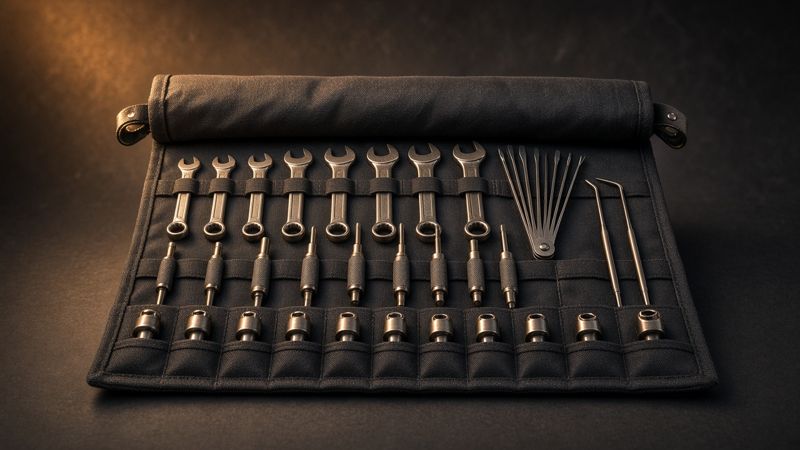
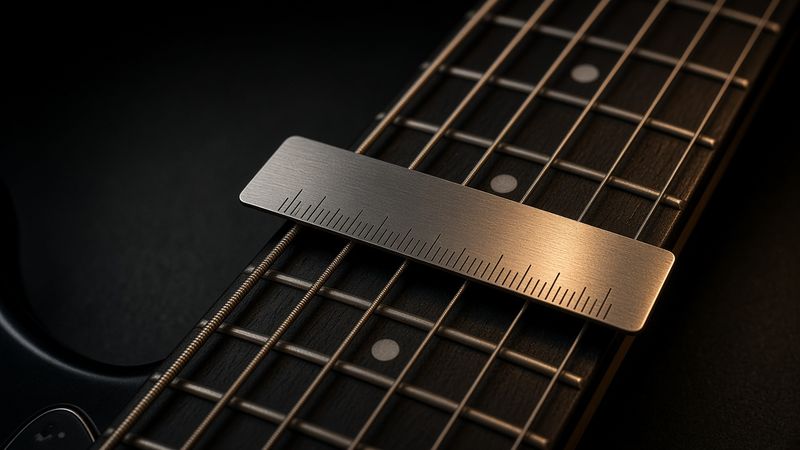
Most high-action fixes are diagnosis, not shopping. The action gauge first: you cannot compare against your maker's spec with a guess, and this ruler is how the 12th-fret check becomes a measurement instead of an opinion. The kit and wrenches earn their place for the electric saddle job and general setup checks: the D'Addario maintenance kit is the all-in-one route (its multi-tool covers the common saddle and truss sizes its contents list names), and the Bondhus wrench set is the cheaper alternative if wrenches are all you need - read the honest either/or framing on our fret buzz page before owning both. Fresh strings belong in the diagnosis too: a dead, heavy, or wrong-gauge set can masquerade as "high" through sheer stiffness, which is why the gauge finder is linked before any tool. Everything below gets an Amazon-check button; only the kit carries a verified maker price.
Illustration - AI-generated, not a photo of the exact product.
StarterMusicNomad Precision String Action Gauge Ruler (MN602)
How the 12th-fret check becomes a measurement: lay it at the 12th fret, read each string's height, and compare against your maker's published spec for your model - never against a universal number.
No list price listed here - we only publish prices we verified on a manufacturer/retailer page. Check the maker and Amazon for current pricing.
Precision string action gauge ruler for measuring string height (standard and metric variantsMN602; per MusicNomad)
Maker/retailer source for the price & specs above (citation, not a buy link): MusicNomad
See price on Amazon
As an Amazon Associate, FretCompare earns from qualifying purchases. Price shown only on Amazon.
Illustration - AI-generated, not a photo of the exact product.
SeriousD'Addario Guitar Maintenance Kit
One kit for restringing, cleaning and basic setup checks
$99.99
Manufacturer/retailer list price (not an Amazon price): D'Addario product page - checked 2026-10-18. Confirm before buying.
Pro-Winderneck cradle/headstandmulti-toolstring height gaugefret polishing systemmat and case (per D'Addario)
Maker/retailer source for the price & specs above (citation, not a buy link): D'Addario
See price on Amazon
As an Amazon Associate, FretCompare earns from qualifying purchases. Price shown only on Amazon.
Illustration - AI-generated, not a photo of the exact product.
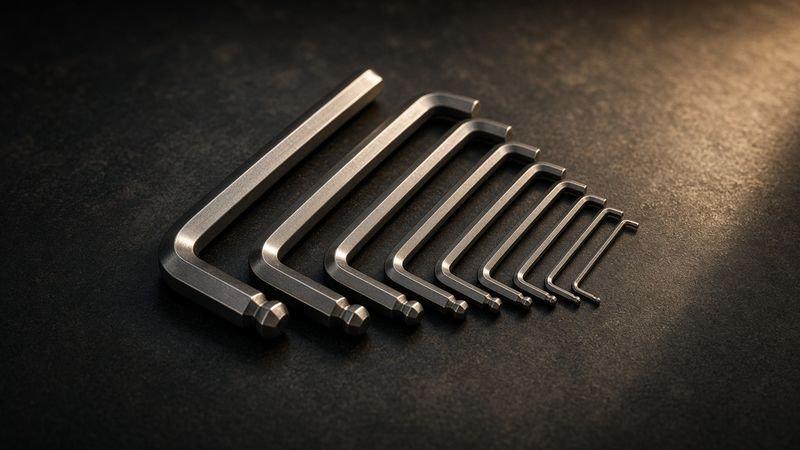
Step-upBondhus 20199 Balldriver L-Wrench Double Pack (BLX22, 22-piece)
The cheaper alternative to a full maintenance kit for saddle-height and careful setup checks: .050in and 1.5mm cover saddle screws, 1/8in (Fender USA truss), 3/16in (Fender Mexico truss) and 4mm/5mm (many import and Squier truss rods) cover the truss sizes guitarists actually meet. Honest limits: ball ends are for access at low torque - use the flat short end, fully seated, for a truss rod; and most Gibsons adjust with a 5/16in socket, not a hex key, so this set does not help there.
No list price listed here - we only publish prices we verified on a manufacturer/retailer page. Check the maker and Amazon for current pricing.
Ball-end L-wrenchesProTanium steelmade in USAlifetime warranty (per Bondhus). Metric 1.522.53456810mm + SAE .0501/165/643/327/641/89/645/323/167/321/45/163/8in; ball ends enter at up to 25 degrees (per Bondhus)
Maker/retailer source for the price & specs above (citation, not a buy link): Bondhus
See price on Amazon
As an Amazon Associate, FretCompare earns from qualifying purchases. Price shown only on Amazon.
Illustration - AI-generated, not a photo of the exact product.
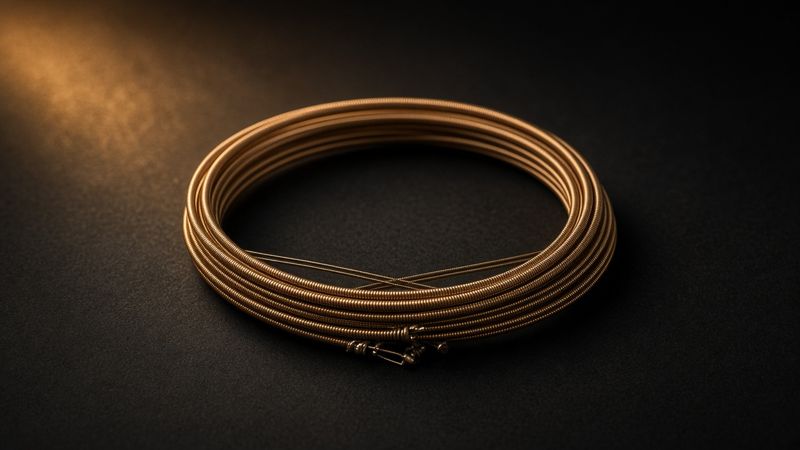
Our pickElixir Acoustic Phosphor Bronze NANOWEB Light .012-.053 (16052)
Our pick for most acoustic beginners: warmth plus sparkle, and months between changes
No list price listed here - we only publish prices we verified on a manufacturer/retailer page. Check the maker and Amazon for current pricing.
Phosphor bronze wrapNANOWEB coatingrich and full tonesmooth feel (per Elixir)
Maker/retailer source for the price & specs above (citation, not a buy link): Elixir
See price on Amazon
As an Amazon Associate, FretCompare earns from qualifying purchases. Price shown only on Amazon.
Prices last checked: Oct 2026 where a verified price is shown on a card - confirm at checkout. Editorial from published facts, not hands-on testing: How we rate.
When it is a tech job, full stop
Book a setup when: the relief check shows a twisted or stubborn neck; the nut is the cause; an acoustic needs saddle material removed and you are not confident; the neck angle itself is wrong (high at the bridge even with a low saddle - a neck-reset conversation on acoustics, not an adjustment); or frets are uneven, which no height adjustment fixes evenly. Money expectations belong to our first setup budget page - this page deliberately owns diagnosis only, and links there rather than quoting figures it cannot verify. A good setup also sets intonation, which is the third page of this hub: if the guitar plays at the right height but sounds wrong up the neck, continue to the intonation fix.
FAQ
How do I fix high action on my guitar?
Diagnose which of the three causes you have before adjusting anything: neck relief, saddle height, or nut height, in that checking order. Electric saddle screws are reversible and beginner-safe to try in small moves; acoustic saddle sanding removes material permanently; nut work is a tech job for most beginners. And do not use the truss rod as an action knob - it sets relief, not string height.
Why is my guitar action too high at the 12th fret?
Because the 12th fret is where relief and saddle height add up most visibly: a neck with too much forward bow lifts the middle of the string's path, and a tall saddle lifts the whole path. Measure or compare yours against your maker's published spec for your model rather than any universal number, then check relief first, saddle second, nut last.
Can I lower my action without touching the truss rod?
Often, yes. If relief is already in your maker's range, saddle height is the action adjustment: individual saddle screws on most electrics, or (carefully, irreversibly) sanding an acoustic saddle. The truss rod only belongs in the job when the relief check shows the neck itself is bowed too far forward or back.
Are my guitar strings too high, or is it my technique?
Both can be true, which is why we check the guitar first: compare your string height at the 12th fret with your maker's spec and try the relief test below. If the guitar measures in-spec and still feels hard, lighter strings or a lighter touch may be the honest answer - see the string gauge finder rather than forcing the setup lower and inventing fret buzz.
How much does it cost to lower guitar action?
A setup price varies by tech and region and often by what the setup finds, so we do not print one - our first-setup budget page explains how to budget for bench work honestly. Ask for a setup quote and say the words 'action feels high at the 12th fret'; that sentence gets you a straighter answer than 'make it play better'.
Setup hub: Fret buzz fix - Guitar intonation fix - Fret sprout fix - Won't stay in tune - String gauge finder - Tools & care kit
 ILLUSTRATION