Affiliate disclosure: product buttons link to Amazon. As an Amazon Associate, FretCompare earns from qualifying purchases, at no extra cost to you. It never changes which products we pick, and we never show Amazon prices. Details
Guitar Setup: What It Is, What It Costs and Is It Worth It?
Quick answer: a setup adjusts a guitar so it plays easily and in tune: neck relief (truss rod), string height (action), nut slots, intonation and pickup height, usually with new strings and a clean. Wirecutter puts a typical professional setup at around $50, rising past $100 if the guitar needs more work, with strings sometimes extra - ask before you book. For beginners, especially with a budget or online-bought guitar that feels hard to play, it's usually worth it.
Editorial guide from Fender's setup guidance and Wirecutter (see Sources). The setup cost is Wirecutter's published estimate (2019), not a FretCompare quote; local prices vary. Not hands-on testing.
Last verified Oct 2026. Facts on this page come from the official pages listed under Sources checked. Editorial guidance, not hands-on testing. See the sources.
What a guitar setup includes
Fender compares a setup to a car tune-up and lists the usual parts:
Adjustment
What it does
Truss rod (neck relief)
Sets the slight forward bow in the neck. Fender's Stratocaster guide measures relief at the 8th fret with the string capoed at the 1st fret and pressed at the last fret.
Action (string height)
How high the strings sit. Fender measures electric action at the 17th fret; lower is easier to press but can buzz.
Nut
Slot depth and smoothness - too high makes first-position chords hard and sharp; a sticky nut causes tuning problems.
Bridge / saddles
Height and string length at the bridge.
Intonation
Makes fretted notes in tune up the neck: compare the 12th-fret harmonic with the fretted 12th-fret note and move the saddle.
Seasonal changes: Fender notes temperature and humidity affect the neck.
What a setup costs
Wirecutter's guide says most music stores offer setups or can refer you, that prices vary by region and how much work is needed, and that a professional setup generally costs around $50 and could be upwards of $100. Strings may be included or extra. Fret levelling, nut replacement or saddle work cost more. Get a quote and ask what's included. (This is a service estimate for guidance, not a product price.)
Is a setup worth it?
Wirecutter's answer is "it depends", and its reasoning is useful:
Absolute beginners: probably go professional - it gives you a baseline for how the guitar should feel.
Guitars bought online or budget models: factory setups are less likely to be optimised, so a setup can make a big difference.
If a new guitar is unplayable or buzzy after a few weeks, Wirecutter calls that a red flag - consider returning it.
Acoustics are harder to DIY than electrics, because lowering action usually means sanding the saddle.
Our view: if your fingers hurt more than they should, or you're older or have hand pain, a setup is one of the best-value upgrades - see sore fingers and learning guitar over 50.
What you can safely check yourself
Tune to pitch with fresh strings.
Action: measure the gap at the 12th fret (acoustic) or 17th (Fender electric guidance) with a ruler or action gauge, and compare with your maker's spec.
Relief: capo the 1st fret, press the low E at the last fret, and look at the gap around the 8th fret.
Intonation: compare 12th-fret harmonic and fretted note on a tuner.
Fender advises taking the guitar to a technician if a truss rod meets excessive resistance, needs constant adjustment, has no effect, or you're not comfortable. Wirecutter calls nut filing the adjustment most likely to get a beginner into trouble.
Acoustic vs electric setups
Electrics have adjustable saddles for height and intonation, so many players learn to do basic setups with a small screwdriver or hex key. Most acoustics have a fixed bridge with a bone or plastic saddle; lowering action means sanding the saddle, and fixing intonation can mean a new saddle - a job for a tech.
How to book a good setup
Ask a local luthier or independent shop, or a store with an in-house tech.
Tell them how you play and any comfort needs ("easiest playability without buzz", "I have arthritis").
Ask what's included, whether strings are extra and the gauge they'll use.
Play the guitar before you leave.
Tools for DIY checks
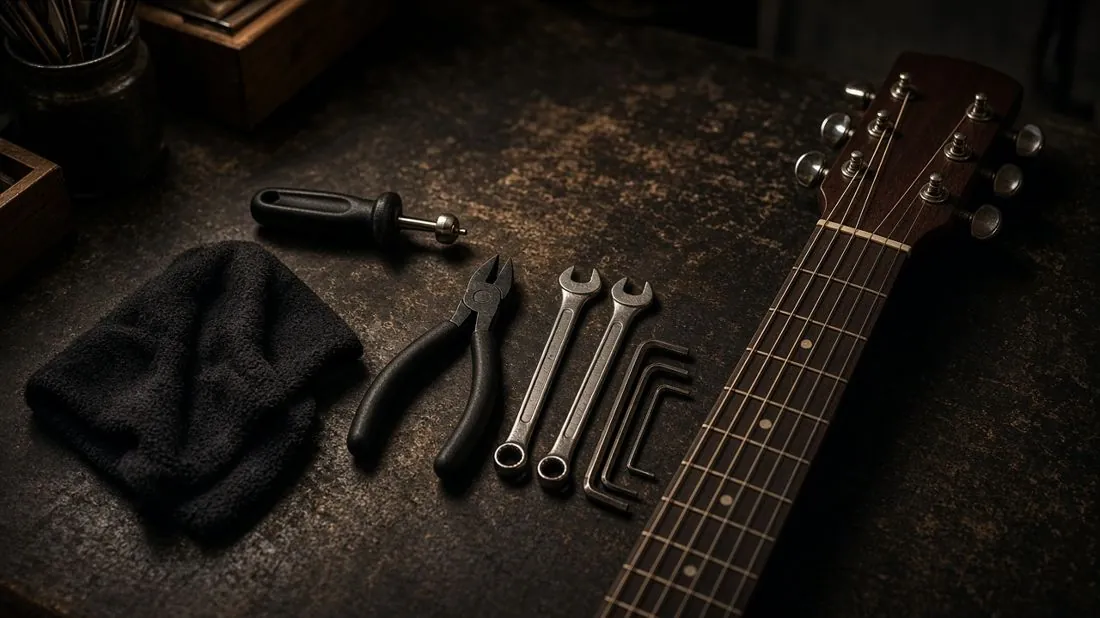
For measuring and basic electric adjustments, these are the tools we list elsewhere in our tools guide. Specs from each maker's page; buttons go to the exact Amazon listing.
ILLUSTRATION
Illustration - AI-generated, not a photo of the exact product.
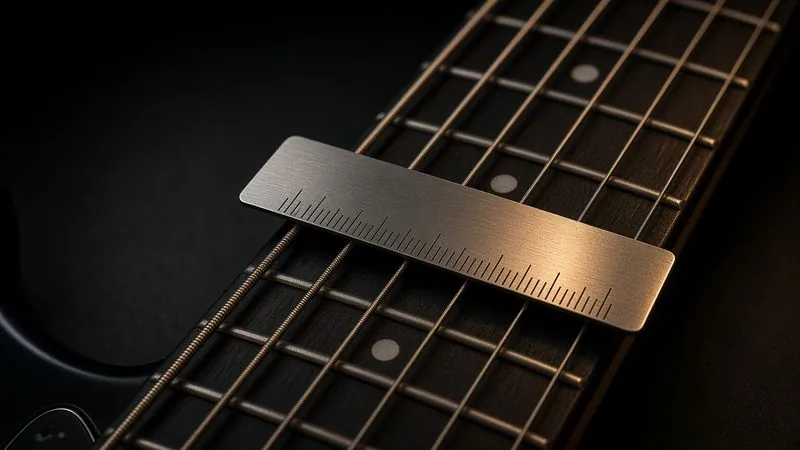
Best for How the 12th-fret check becomes a measurement: lay it at the 12th fret, read each string's height, and compare against your maker's published spec for your model - never against a universal number.
Precision string action gauge ruler for measuring string height (standard and metric variantsMN602; per MusicNomad)
Specs: MusicNomad official product page, checked 2026-10-18.
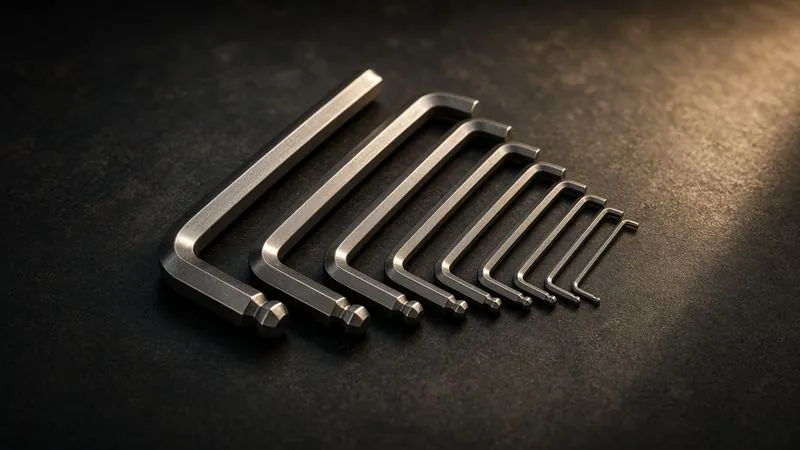
Best for The cheaper alternative to a full maintenance kit for saddle-height and careful setup checks: .050in and 1.5mm cover saddle screws, 1/8in (Fender USA truss), 3/16in (Fender Mexico truss) and 4mm/5mm (many import and Squier truss rods) cover the truss sizes guitarists actually meet. Honest limits: ball ends are for access at low torque - use the flat short end, fully seated, for a truss rod; and most Gibsons adjust with a 5/16in socket, not a hex key, so this set does not help there.
Ball-end L-wrenchesProTanium steelmade in USAlifetime warranty (per Bondhus). Metric 1.522.53456810mm + SAE .0501/165/643/327/641/89/645/323/167/321/45/163/8in; ball ends enter at up to 25 degrees (per Bondhus)
Specs: Bondhus official product page, checked 2026-10-18.
As an Amazon Associate, FretCompare earns from qualifying purchases. Price shown only on Amazon.
FAQ
How often should a guitar be set up?
Many players have it checked once or twice a year, and after big seasonal humidity changes or a change of string gauge.
Does a new guitar need a setup?
Not always. If it plays easily, stays in tune and doesn't buzz, it's fine. Budget and online-bought guitars benefit most.
Will a setup make a cheap guitar play better?
Often, yes - action, nut height and intonation make a big difference in how easy any guitar is to play.
Can I set up my own guitar?
Basic electric checks and saddle adjustments, yes. Nut filing, saddle sanding and stubborn truss rods are best left to a tech.
Sources checked
Fender: Why you should get a guitar setup (what a setup addresses) (checked Oct 21 2026): www.fender.com/articles/setup/what-is-a-setup-and-why-is-it-so-crucial
Fender: How to set up a guitar (setup components) (checked Oct 21 2026): www.fender.com/pages/how-to-set-up-guitar
Fender Support: How do I set up my Stratocaster properly? (relief at 8th fret, action at 17th, when to see a tech) (checked Oct 21 2026): support.fender.com/hc/en-us/articles/42584764005019-How-do-I-set-up-my
Fender: Intonation 101 (checked Oct 21 2026): www.fender.com/articles/maintenance/intonation-101
Wirecutter: Should you have your guitar or bass professionally set up? (cost around $50, upwards of $100; published Sep 5 2019) (checked Oct 21 2026): www.nytimes.com/wirecutter/blog/should-you-have-your-guitar-or-bass-pr
Not hands-on testing: FretCompare summarises official instructions and published facts. Steps and terms change, so follow the official page if it differs.
How this page was made
Picks are editorial, from maker specs and published facts - not hands-on testing. Each product button goes to the exact Amazon listing for that model. How we rate.
Update log: 2026-10-20 - every product button re-checked against its exact Amazon listing (ASIN, title and seller).
Free printable: Beginner Gear Checklist - no email needed: Open the checklist.
Free 7-Day First Chords course - Confirm your email first (Kit sends a confirmation link). Day 1 arrives the next morning (about 9 AM Central), then one short email a day until Day 7: setup, first chords, strumming, a first song. Unsubscribe any time.
 ILLUSTRATION